

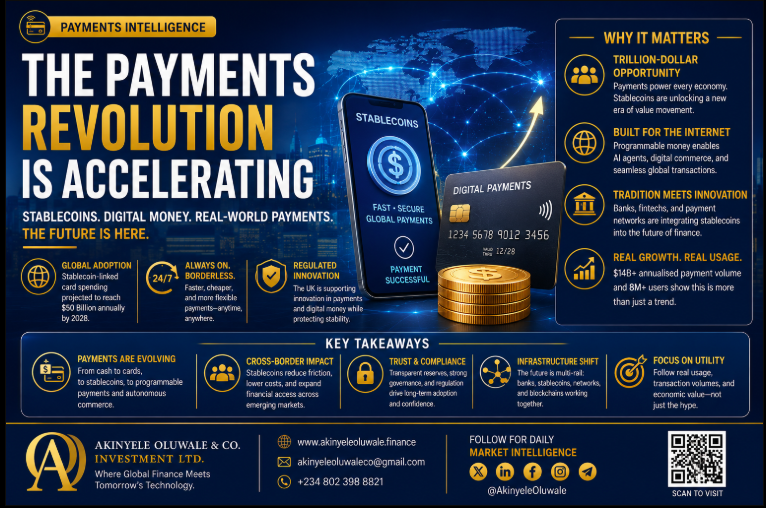
The Payments Revolution Is Accelerating: Stablecoins Move From Crypto Rails to Everyday Money
Global payments are entering a structural transition. Stablecoin-linked card spending is projected to reach $50 billion annually by 2028, while Britain is reshaping its regulatory framework around digital-money innovation. The important story is no longer crypto payments versus traditional payments it is how the two systems are beginning to merge.
Published: 27 August 2026
Category: Payments • Stablecoins • Digital Finance • Banking
By: Akinyele Oluwale & Co. Investment Ltd.
Executive Summary
Payments may become one of blockchain's most commercially important applications.
Global stablecoin-linked card spending is projected to reach $50 billion annually by 2028, roughly four times current levels, according to payments company RedotPay. Stablecoin card spending exceeded $1 billion during July alone. (Reuters)
At the same time, Britain plans to give the Bank of England a new secondary objective supporting innovation in payments and digital money while maintaining financial stability as its primary responsibility.
Put those developments together and the direction becomes clearer:
Digital money is moving from experimentation into payment infrastructure.
What Happened?
Stablecoin payment adoption is expanding beyond crypto-native users.
RedotPay, which reports more than 8 million users, says its annualised payment volume has exceeded $14 billion across card spending and account top-ups. Latin America currently leads adoption potential, followed by Africa.
Meanwhile, the Bank of England is developing rules allowing systemic stablecoins to operate as trusted payment instruments at scale. Its framework explicitly identifies faster, cheaper and more flexible payments including cross-border transactions as potential benefits. (Bank of England)
That represents an important transition.
Stablecoins are increasingly being designed to move money, not merely move between crypto trades.
Background
Traditional payments have improved dramatically, but international money movement can still involve multiple intermediaries, settlement delays and foreign-exchange friction.
Stablecoins introduce another architecture:
Fiat Currency → Stablecoin → Blockchain Settlement → Merchant/Bank Account
The consumer may eventually never notice that blockchain was involved.
That is precisely the point.
Successful infrastructure usually becomes invisible.
Why It Matters
Payments are enormous because they sit underneath almost every economic transaction.
Stablecoins potentially add three characteristics traditional infrastructure cannot always provide simultaneously:
24/7 Availability + Global Reach + Programmability
The Bank of England itself envisions a future where conventional deposits, tokenized bank deposits, regulated stablecoins and potentially a retail CBDC coexist within a broader “multi-money” system.
This suggests the future isn't necessarily stablecoins replacing banks.
It could be different forms of digital money becoming interoperable.
Winners & Losers / Key Stakeholders
Payment companies, stablecoin issuers, banks, blockchain networks, custodians and fintech infrastructure providers all have opportunities.
But competition will intensify.
Card networks are integrating blockchain capabilities. Banks are experimenting with tokenized deposits. Stablecoin companies are building payment networks. Blockchains are competing for settlement volume.
The weakest position may belong to infrastructure that remains slow, expensive and difficult to integrate.
Short-Term Impact
The immediate opportunity is likely strongest in cross-border payments and regions where existing payment infrastructure creates significant friction.
But investors should separate transaction growth from investment returns.
A blockchain processing billions in payments does not automatically mean its native token captures equivalent economic value.
The crucial question is:
Who actually earns money when the transaction occurs?
Long-Term Impact
The next transformation could come from artificial intelligence.
The Bank of England says increasingly autonomous AI systems could change how payments are initiated and executed, while also creating new challenges involving authorization, fraud, liability and settlement certainty.
AI agents don't need plastic cards.
They need programmable payment infrastructure.
That could eventually make stablecoins and tokenized deposits important settlement tools for machine-to-machine commerce.
Editorial Perspective
The payments industry is not being destroyed.
It is being rebuilt in layers.
Banks may still hold customer relationships.
Card networks may still provide distribution.
Stablecoins may provide digital money.
Blockchain may provide settlement.
AI may eventually initiate the transaction.
The winners will be those capable of connecting these layers securely and cheaply.
What to Watch Next
Watch stablecoin payment volumes, merchant adoption, cross-border corridors, bank-issued tokenized deposits, regulatory implementation and transaction costs.
Above all, watch actual usage.
Partnership announcements tell us where companies want to go.
Payment volume tells us whether customers followed.
Investing Lesson
Follow payment flows before narratives.
For any payments investment, ask four questions:
Who owns the customer? Who processes the transaction? Who earns the fee? Who captures the long-term value?
That is where infrastructure adoption becomes an investment thesis.
Key Takeaways
The evolution is accelerating:
Cash → Cards → Digital Wallets → Stablecoins → Programmable Payments → Autonomous Commerce
Each stage reduces friction and increases programmability.
Editorial Bottom Line
The future of payments probably won't be exclusively blockchain or traditional banking.
It will likely be hybrid.
Banks, stablecoins, payment networks and blockchains are beginning to connect into a new financial architecture.
The real revolution arrives when consumers stop caring which rail moved their money and simply expect value to move instantly, globally and reliably.
Akinyele Oluwale & Co. Investment Ltd.
Where Global Finance Meets Tomorrow's Technology.