

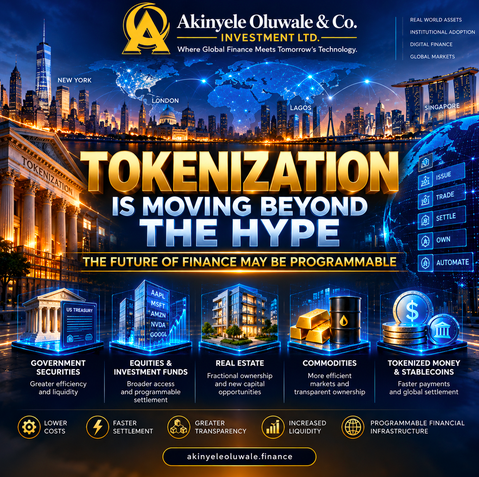
Tokenization Is Moving Beyond the Hype: Why Real-World Assets Could Reshape Global Finance
Published: October 2, 2026
Category: Tokenization & RWAs
By: Akinyele Oluwale
Executive Summary
Tokenization is gradually moving from a crypto-sector experiment toward a serious financial-infrastructure discussion.
Government securities, investment funds, private credit, equities, real estate and other financial claims can increasingly be represented on programmable digital infrastructure.
The important question is therefore no longer simply whether traditional assets can be tokenized.
It is whether tokenization can meaningfully improve issuance, ownership, trading, settlement, collateral management and capital formation.
For investors, this distinction is critical.
Tokenization does not automatically create economic value. Its importance depends on the quality of the underlying asset, the legal rights attached to it and whether the technology solves a genuine financial problem.
What Exactly Is Tokenization?
Consider a government bond worth $1 million.
Traditionally, ownership and transactions involving that bond are recorded and processed through established financial institutions and securities-market infrastructure.
Tokenization creates a digital representation of the financial claim on programmable infrastructure.
In simple terms:
Traditional Asset → Digital Representation → Programmable Financial Infrastructure
But the technology does not eliminate the importance of the underlying asset.
The U.S. Securities and Exchange Commission has described tokenized securities as securities represented through crypto assets where ownership records are maintained wholly or partly using crypto networks. It has also emphasized that different structures can give investors different legal and economic rights.
That leads to one of the most important principles investors should remember:
A token is only as economically meaningful as the asset, legal rights and institutional arrangements behind it.
Why Tokenize Financial Assets?
Modern financial markets are sophisticated, but they also contain substantial operational infrastructure.
A transaction may involve several participants:
Investor → Broker → Exchange → Clearing → Custodian → Settlement
Different institutions maintain records that must be communicated, reconciled and ultimately settled.
Tokenization could potentially allow some of these activities to operate on shared programmable infrastructure.
The Bank for International Settlements has argued that tokenization could combine messaging, reconciliation and settlement more efficiently within a unified architecture.
Potential benefits include:
Assets and payments could potentially move more efficiently when both operate on compatible digital infrastructure.
Rules and conditions can potentially be embedded directly into transactions.
Certain administrative processes could execute automatically once predetermined conditions are satisfied.
Some assets could be divided into smaller economic units, potentially widening accessibility where regulation and market economics permit.
Shared digital records may improve visibility into certain transactions and ownership structures.
But one concept is particularly important.
Atomic Settlement Could Change Financial Infrastructure
Suppose one investor buys an asset from another.
Two things must happen:
Buyer sends money.
Seller transfers the asset.
Traditional markets coordinate those two sides through financial infrastructure.
Programmable systems can potentially make them occur simultaneously:
Either both sides settle or neither does.
This is known as atomic settlement.
The BIS's Project Agorá has demonstrated the technical feasibility of using tokenized commercial-bank deposits and central-bank reserves in wholesale cross-border payment arrangements.
That illustrates why tokenization is potentially much more significant than simply placing an asset on a blockchain.
The Tokenized RWA Market Is Already Developing
This is no longer entirely theoretical.
As of October 1, 2026, RWA.xyz reported approximately $38.55 billion in distributed tokenized real-world assets, excluding the substantially larger stablecoin market.
Its data also showed more than 5 million holders of distributed tokenized RWAs.
Ethereum accounted for a significant portion of distributed RWA value, while several other networks also supported tokenized assets.
Stablecoins are already operating at a much larger scale, with RWA.xyz reporting approximately $294 billion in total stablecoin value.
However, investors should be careful when interpreting tokenization statistics.
Different datasets use different definitions.
Some count only assets distributed on public blockchain networks.
Others may include assets represented digitally through broader infrastructure.
Therefore, whenever a large tokenization number appears, the first analytical question should be.
What exactly is being measured?
Government Securities Could Be One of the Biggest Opportunities
Government bonds could become particularly important in the tokenization story.
They already serve multiple functions within global finance:
The BIS estimates that almost $80 trillion of government bonds are outstanding globally.
At that scale, even modest improvements in settlement, collateral mobility or operational efficiency could have meaningful consequences.
This is why tokenized government securities may ultimately matter considerably more to global finance than speculation around individual crypto tokens.
Tokenized Equities Are Also Moving Forward
The development is expanding beyond bonds.
On September 17, 2026, the U.S. SEC introduced temporary conditional relief permitting limited trading of certain tokenized U.S.-listed securities through qualifying Tokenized Securities Venues.
This does not mean the U.S. stock market has suddenly moved onchain.
It does indicate that regulators are beginning to provide controlled environments for experimenting with alternative securities-market infrastructure.
The SEC has identified potential applications of tokenization across areas including issuance, trading, transfer, settlement and ownership records.
That changes the nature of the conversation.
Tokenization is increasingly becoming a capital-markets infrastructure story, not simply a cryptocurrency story.
Central Banks Are Looking at the Same Transformation
Central banks are also examining programmable financial infrastructure.
One model explored by the BIS combines:
Tokenized central-bank reserves
Tokenized commercial-bank deposits
Tokenized government securities
into a programmable financial architecture.
Project Agorá involves eight central banks and more than 40 private-sector financial institutions examining whether tokenization could improve wholesale cross-border payments while maintaining the safeguards required by the regulated financial system.
This suggests an important possibility.
The future of tokenization may not involve replacing traditional finance.
It could involve rebuilding parts of traditional finance on more programmable infrastructure.
Tokenization Does Not Eliminate Investment Risk
This is where investors need discipline.
Putting an asset on blockchain infrastructure does not automatically make the underlying investment safer.
Consider tokenized property.
If the property loses value, its digital representation can also lose value.
If a borrower defaults on tokenized private credit, blockchain technology does not eliminate the economic loss.
Investors therefore still face fundamental risks.
Credit Risk
The borrower or issuer may fail to meet its obligations.
The underlying asset can decline in value.
Tokenization does not guarantee that buyers will exist when an investor wants to sell.
The relationship between the token and legal ownership of the underlying asset must be clearly established.
Digital financial assets require secure custody arrangements.
Smart contracts and digital infrastructure can contain vulnerabilities or fail.
Different tokenization platforms may not communicate effectively.
That final issue deserves particular attention.
If every institution builds its own incompatible tokenization platform, finance could simply replace today's fragmented infrastructure with a different form of fragmentation.
Regulation and Custody Are Becoming Critical
Institutional adoption requires more than technology.
It requires credible answers to fundamental questions:
Who owns the asset?
Who holds the asset?
How is ownership verified?
What happens if a custodian fails?
Which law governs the transaction?
What protections does the investor have?
On October 1, 2026, the SEC proposed a framework addressing how investment advisers and funds custody crypto assets, illustrating how digital-asset custody is increasingly becoming part of mainstream securities regulation.
These questions may appear technical.
For institutional investors, they are fundamental.
What Investors Should Actually Watch
The biggest analytical mistake would be reducing this entire transformation to:
“Which RWA token should I buy?”
That starts at the wrong end of the investment process.
Instead, investors should ask:
Government securities?
Equities?
Investment funds?
Private credit?
Real estate?
Commodities?
Institutional credibility matters.
Digital representation does not automatically mean direct ownership of an underlying asset.
Infrastructure matters.
Stablecoins?
Tokenized commercial-bank deposits?
Central-bank money?
Technology cannot manufacture buyers and sellers.
Lower costs?
Faster settlement?
Better collateral mobility?
Broader distribution?
Improved transparency?
Automation?
If tokenization solves no meaningful economic or operational problem, the technology alone does not create investment value.
The Bigger Investment Thesis
The long-term thesis may be considerably larger than:
“Real-world assets are coming to crypto.”
A more important possibility is:
Parts of global finance may gradually become programmable.
Consider the potential architecture:
Assets
↓
Tokenized Ownership
↓
Programmable Money
↓
Automated Settlement
↓
Digital Custody
↓
Programmable Financial Markets
This could eventually affect the assets themselves, the money used to purchase them, settlement infrastructure, ownership records and some contractual processes surrounding financial transactions.
That is why investors should pay attention not only to individual blockchain networks but also to:
central banks, securities regulators, commercial banks, asset managers, exchanges, custodians and market-infrastructure providers.
The ultimate winner of tokenization may not be one particular token.
It could be an entirely new architecture for financial markets.
What This Means for Investors
The investment lesson is straightforward:
Do not confuse technological innovation with investment quality.
A tokenized asset should still be analysed like an investment.
Understand:
the underlying asset,
the cash flows,
the issuer,
the legal structure,
the liquidity,
the custody arrangements,
the technology,
and ultimately:
Technology can improve infrastructure.
It cannot repeal investment fundamentals.
Final Thought
Every major technological transformation goes through a stage when speculation receives more attention than infrastructure.
Tokenization increasingly appears to be entering the infrastructure phase.
The question is therefore evolving from:
to:
“Which parts of global finance should become tokenized and what infrastructure will connect them?”
That is the question worth watching.
Because the real transformation may not simply be bringing traditional assets onto blockchain networks.
It may be making global finance programmable.
Related Intelligence
Stablecoins & Payments - The development of programmable money and digital settlement.
Institutional Finance — How banks, asset managers and regulated financial institutions are approaching digital assets.
Blockchain & Technology — The infrastructure supporting the next generation of financial markets.
Macro & Global Markets — How changing market structures affect capital allocation and investment.
About the Author
Akinyele Oluwale
Founder & Chief Investment Strategist
Akinyele Oluwale & Co. Investment Ltd.
Research and commentary covering global finance, macroeconomics, digital assets, institutional crypto, tokenization, artificial intelligence and emerging financial technology.
Editorial
Akinyele Oluwale & Co. Investment Ltd.
Where Global Finance Meets Tomorrow’s Technology.
akinyeleoluwale.finance