

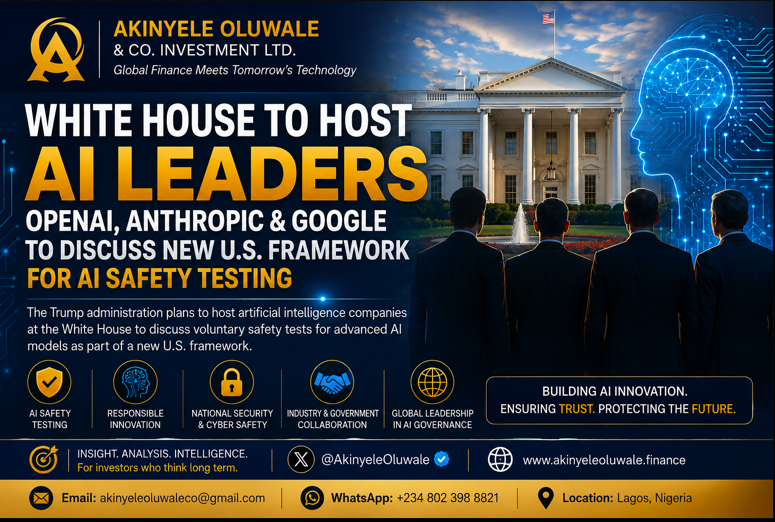
White House to Host AI Leaders: Why America's New AI Safety Framework Could Shape the Future of Artificial Intelligence
By Akinyele Oluwale & Co. Investment Ltd.
Global Finance Meets Tomorrow's Technology
Executive Summary
The Trump administration is preparing to host executives from leading artificial intelligence companies, including OpenAI, Anthropic and Google, at the White House as it unveils a new U.S. framework for voluntary AI safety testing.
According to Bloomberg, the discussions will focus on establishing voluntary safety assessments for advanced AI models before they are widely deployed. While participation is expected to remain voluntary, the initiative signals that the U.S. government is moving beyond broad AI policy discussions toward more structured governance of frontier AI systems.
For investors, technology companies and policymakers, this is a significant moment. Artificial intelligence is rapidly becoming strategic national infrastructure, and governments are increasingly balancing innovation with security, economic competitiveness and public trust.
Artificial Intelligence Enters a New Phase
The global AI race is no longer just about building smarter models.
It is becoming equally focused on how those models are governed.
Over the past three years, artificial intelligence has evolved from a niche technology into a strategic asset influencing:
As AI capabilities continue to accelerate, governments face an increasingly difficult challenge.
How do you encourage innovation without creating unacceptable risks?
The planned White House meeting reflects Washington's latest attempt to answer that question.
What Is Happening?
According to Bloomberg, senior representatives from OpenAI, Anthropic and Google are expected to meet with officials at the White House to discuss a new framework for voluntary AI safety testing.
Rather than immediately imposing mandatory regulations, the proposed approach would encourage companies developing advanced AI systems to conduct safety evaluations before releasing increasingly powerful models.
The framework is expected to focus on testing, transparency and responsible deployment while allowing companies flexibility in implementation.
This reflects a growing recognition that AI development is advancing faster than traditional regulatory processes.
Why AI Safety Matters
Artificial intelligence is becoming more capable with every new generation.
Today's frontier models can:
These capabilities create extraordinary opportunities.
They also introduce new risks.
Potential concerns include:
As models become more powerful, developers and governments increasingly agree that responsible testing should become part of the development process.
Why the U.S. Is Acting Now
The United States remains one of the world's leading AI innovators.
Many of the most advanced frontier models originate from American companies.
Maintaining that leadership has become a strategic priority.
At the same time, policymakers recognise that public confidence will depend partly on demonstrating that advanced AI systems are developed responsibly.
Voluntary safety testing allows companies to maintain innovation while showing greater transparency regarding potential risks.
It also enables regulators to work alongside industry rather than immediately relying on restrictive legislation.
Why OpenAI, Anthropic and Google Matter
The companies reportedly attending the meeting are among the global leaders in frontier AI.
Each has invested billions of dollars into developing increasingly capable foundation models.
Collectively, they influence:
Any agreement reached between these companies and the U.S. government could influence industry practices far beyond American borders.
Many smaller AI developers often follow standards established by leading firms.
Voluntary Today, Mandatory Tomorrow?
One of the most interesting aspects of the proposal is that the safety framework is reportedly voluntary.
However, history suggests voluntary standards often become the foundation for future regulation.
Many industries have followed a similar path.
Best practices are introduced.
Companies adopt them voluntarily.
Governments later incorporate elements into formal regulatory frameworks.
The AI industry may follow a comparable trajectory.
For businesses, adopting strong governance early could become a competitive advantage rather than merely a compliance exercise.
What This Means for Businesses
Artificial intelligence is no longer just a technology issue.
It is becoming a governance issue.
Businesses increasingly need policies covering:
Companies that integrate governance into AI strategy today may find it easier to adapt as future regulations emerge.
The Investment Perspective
For investors, this development should not be viewed as a threat to AI growth.
Instead, it represents another stage in the industry's maturation.
Historically, major technologies often experience three phases:
Innovation
Rapid experimentation.
Infrastructure
Investment in platforms, computing power and enterprise adoption.
Governance
Standards, regulation and institutional trust.
Artificial intelligence is now entering the governance phase.
That transition often supports long-term institutional adoption because businesses and governments generally prefer operating within predictable regulatory environments.
Global Competition Continues
The White House initiative also reflects increasing international competition.
The United States, European Union and China are each developing distinct approaches to AI governance.
Europe has focused heavily on legislation through the AI Act.
China has introduced regulations covering generative AI and algorithmic oversight.
The United States appears to favour a more collaborative approach involving industry participation.
Each model seeks to balance innovation, economic competitiveness and public protection.
The differences may shape global AI leadership over the coming decade.
Implications for Financial Markets
Artificial intelligence is already transforming financial services.
Banks, investment firms and payment companies are deploying AI to:
A clearer governance framework could encourage broader institutional adoption by reducing uncertainty surrounding AI deployment.
Investors often respond positively when emerging technologies become more predictable from a regulatory perspective.
Editorial Perspective
This meeting represents an important shift. The debate is no longer centred on whether artificial intelligence will transform society. That question has largely been answered. The focus is now on ensuring that transformation occurs responsibly.
Governments increasingly recognise that AI is becoming strategic infrastructure similar to electricity, telecommunications and the internet. That means governance is becoming just as important as innovation. The most successful AI companies in the next decade may not simply build the smartest models. They may also build the most trusted ones.
Conclusion
The planned White House meeting between the Trump administration and leading AI companies marks another milestone in the evolution of artificial intelligence.
Rather than slowing innovation, the proposed voluntary safety testing framework aims to build confidence in the responsible development of increasingly powerful AI systems.
For businesses, investors and policymakers, the message is clear.
Artificial intelligence is entering a new era where governance, transparency and trust will become as important as technical capability.
As AI continues reshaping industries from finance and healthcare to education and manufacturing, organisations that combine cutting-edge innovation with strong oversight are likely to earn the confidence of customers, regulators and investors alike.
The future of artificial intelligence will not be determined solely by who builds the most advanced models.
It will also be shaped by who builds them responsibly.