

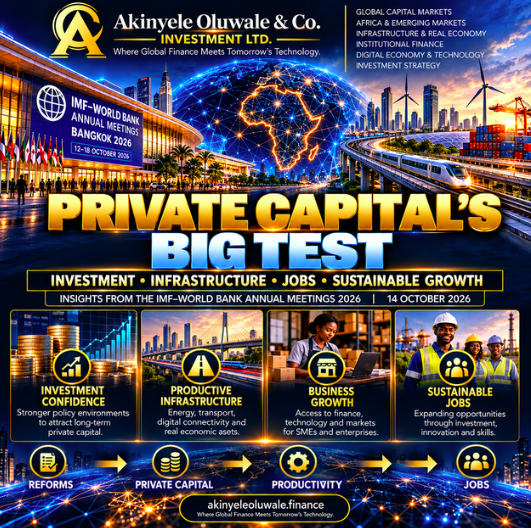
Published: 14 October 2026
Category: Institutional Finance
By: Akinyele Oluwale
The global development-finance conversation is changing. Governments need infrastructure. Businesses need financing.
Emerging economies need investment and growing populations need productive employment opportunities but the amount of capital required to meet these needs is enormous.
For many developing economies, government financing alone cannot sustainably provide all the investment required for electricity, transportation, telecommunications, agriculture, manufacturing and business development.
Public budgets already face competing demands, while higher borrowing and debt-servicing obligations can constrain governments' ability to finance additional development.
That makes one question increasingly important:
This question has moved to the centre of the 2026 IMF–World Bank Annual Meetings in Bangkok.
On 14 October, the World Bank Group's programme places particular emphasis on mobilising private capital for jobs and unlocking investment opportunities across emerging economies.
For Nigeria and Africa, however, attracting capital is only the beginning.
The bigger challenge is converting that capital into functioning infrastructure, productive businesses, higher productivity and sustainable employment.
The development equation is:
The amount of capital attracted matters.
What that capital ultimately produces matters even more.
Private capital is becoming increasingly important to the global development-finance agenda.
The reason is straightforward.
The investment requirements of developing economies are considerably larger than governments and development institutions can finance alone.
Private investors including banks, institutional investors, corporations, infrastructure funds and other financial institutions therefore have an important role.
But capital does not automatically flow toward countries simply because those countries need investment.
Investors evaluate:
Economic stability.
Expected returns.
Currency risk.
Political and regulatory conditions.
Infrastructure.
Legal protections.
Financing costs.
And project viability.
This means that governments seeking greater private investment must create conditions in which productive projects can generate reasonable risk-adjusted returns.
Development-finance institutions can also play an important role by supporting reforms, financing projects and mitigating certain investment risks.
But the objective must extend beyond raising money.
The complete economic process is:
Every stage matters.
And every stage should be measured separately.
The world's emerging economies face a difficult financing challenge.
Infrastructure requirements remain substantial.
Electricity systems need investment.
Transportation networks require expansion.
Digital connectivity must improve.
Agricultural productivity needs strengthening.
Businesses require long-term capital.
At the same time, governments have limited financial resources.
One solution is greater participation from private investors.
Consider a hypothetical $500 million infrastructure project.
The project may offer significant economic benefits.
But before committing capital, investors will ask:
Will the project generate sufficient revenue?
What risks could affect those revenues?
How stable is the regulatory environment?
Who carries construction risk?
How will currency movements affect returns?
Can contracts be enforced?
What happens if costs exceed projections?
These questions illustrate an important principle.
Projects must be structured in ways that appropriately allocate risks and potential returns.
Private capital can help close financing gaps.
But it does not eliminate economic risk.
Instead, it changes how capital and risk are distributed among governments, investors, lenders and other stakeholders.
The IMF–World Bank Annual Meetings are taking place in Bangkok, Thailand, from 12–18 October 2026.
Today's World Bank Group programme includes a flagship discussion focused on Mobilizing Private Capital for Jobs.
The discussion reflects a broader effort to examine how private investment can support businesses, infrastructure and employment.
This is significant.
For decades, development finance was often discussed primarily in terms of government spending, international aid and multilateral lending.
Those sources remain important.
But the scale of global investment requirements has increased the focus on private-sector participation.
A second important issue is the availability of projects capable of attracting private financing.
Emerging economies may possess significant economic opportunities while still struggling to attract investment.
Why?
Because investors do not invest in economic potential alone.
They invest in opportunities where expected returns reasonably compensate for risk.
Barriers can include:
Regulatory uncertainty.
Currency volatility.
Limited infrastructure.
Weak domestic capital markets.
High financing costs.
Insufficient project preparation.
And policy uncertainty.
Therefore, attracting capital requires more than promoting investment opportunities.
Employment is also becoming increasingly important in the development-finance discussion.
Economic growth alone does not necessarily guarantee sufficient employment opportunities.
Countries can experience GDP growth while large parts of the population continue to struggle with unemployment or weak income growth.
This is especially important for economies with rapidly expanding working-age populations.
Investment therefore needs to increase productive capacity.
Productive businesses can expand.
Expansion can increase demand for labour.
And greater productivity can support higher incomes over time.
The desired relationship is:
This is where development finance becomes directly connected to living standards.
Nigeria illustrates both the opportunity and the challenge.
Earlier this week, the World Bank Group highlighted initiatives helping mobilise up to $5.79 billion in private financing for Nigeria in fiscal year 2026.
Potential areas of impact include broadband connectivity, agricultural value chains and access to finance.
The figure is significant.
But investors should interpret it carefully.
Private capital mobilisation is not necessarily the same as money already disbursed.
And money disbursed is not necessarily the same as completed projects.
The proper analytical sequence is:
Maintaining these distinctions is essential for credible financial analysis.
The global private-capital challenge can be understood through five interconnected factors.
Capital generally moves toward environments where investors believe risks can be reasonably assessed.
Predictable regulation matters.
Macroeconomic stability matters.
Contract enforcement matters.
Institutional credibility matters.
Countries do not need to eliminate every investment risk.
That would be impossible.
They need to make risks sufficiently understandable and manageable.
Large investments involve multiple risks.
These may include:
Construction risk.
Operating risk.
Currency risk.
Political risk.
Regulatory risk.
Demand risk.
Financing risk.
The objective is not simply to transfer every risk to investors.
Instead, risks should generally be allocated to the parties best positioned to manage them.
Poorly structured risk allocation can make otherwise valuable projects difficult to finance.
Not every investment requires the same financing approach.
Some projects may use commercial bank loans.
Others may involve equity investment.
Infrastructure projects may use project-finance structures.
Certain investments may involve guarantees or public-private partnerships.
Domestic capital markets can also provide longer-term financing through bonds and other instruments.
The appropriate structure depends on the economics of the underlying project.
Capital should ultimately finance activities capable of generating sustainable economic value.
This includes:
Energy.
Transportation.
Telecommunications.
Manufacturing.
Agriculture.
Technology.
Logistics.
And productive businesses.
The size of an investment does not automatically determine its economic importance.
A smaller project that becomes operational and significantly improves productivity may create more value than a much larger project that remains unfinished.
The final objective is not merely financing.
It is economic development.
Investment should strengthen productive capacity.
Businesses should become more competitive.
Infrastructure should reduce economic inefficiencies.
And sustainable economic opportunities should expand.
This produces the wider development framework:
Greater private investment could increase demand for project finance, corporate lending, transaction banking and advisory services.
Banks can help channel savings toward productive economic activities.
However, increased lending must be accompanied by disciplined credit assessment.
Investment growth should not come at the expense of asset quality.
Infrastructure represents one of the clearest opportunities for private capital.
Electricity, transportation, telecommunications and logistics can increase the productive capacity of an economy.
But projects must remain commercially and economically viable.
Poorly structured infrastructure financing can create financial problems rather than solve them.
Strong domestic bond and equity markets can provide businesses with financing alternatives to traditional bank lending.
They can also help mobilise domestic savings.
For emerging economies, deeper local capital markets may reduce excessive dependence on foreign-currency financing.
Agricultural investment can extend beyond primary production.
Opportunities include:
Processing.
Storage.
Transportation.
Logistics.
Distribution.
Technology.
And market infrastructure.
Strengthening these value chains can improve productivity and reduce waste.
Manufacturing competitiveness depends heavily on infrastructure.
Reliable electricity reduces production disruptions.
Efficient transportation lowers logistics costs.
Access to financing allows businesses to purchase equipment and expand capacity.
Private investment can therefore influence industrial development through several channels.
Digital infrastructure can improve connectivity, financial inclusion and business efficiency.
However, technology investment should ultimately solve real economic problems.
Digital development becomes economically meaningful when it improves productivity, expands market access or reduces transaction costs.
Pension funds, insurance companies, asset managers and infrastructure investors represent potential sources of long-term capital.
But institutional investors require appropriate investment structures and risk-adjusted returns.
Mobilising institutional capital therefore requires a pipeline of credible, investable projects.
At Akinyele Oluwale & Co. Investment Ltd., we believe the global investment conversation must move beyond headline numbers.
A country may announce billions of dollars in investment commitments.
That can be encouraging.
But it does not tell the complete story.
Investors and policymakers should distinguish between five stages.
An investment intention, financing target or proposed transaction is publicly communicated.
Agreements establish financing obligations, subject to their conditions.
Funds are actually released.
The financing produces functioning assets or expanded businesses.
Productivity improves, businesses expand, employment increases or infrastructure becomes more efficient.
These stages are fundamentally different.
Consider two hypothetical countries.
Country A announces $20 billion in investment but struggles with project implementation.
Country B attracts $8 billion but successfully converts the financing into electricity, manufacturing facilities, logistics networks and productive enterprises.
Which country has achieved the better investment outcome?
The answer should not be determined by the headline number alone.
This is particularly important for Nigeria.
The country possesses significant economic potential.
It has a large population.
A substantial domestic market.
Entrepreneurial activity.
Natural resources.
A growing digital economy.
And considerable infrastructure requirements.
These characteristics can create investment opportunities.
But sustainable private investment also requires:
Credible economic reforms.
Regulatory consistency.
Currency stability.
Reliable infrastructure.
Strong institutions.
And disciplined project execution.
Nigeria's investment success should therefore not be measured solely by the number of announcements made.
It should ultimately be measured by the productive capacity created.
Investors should monitor eight indicators.
Are announced financing opportunities becoming binding agreements?
How much money is actually reaching projects and businesses?
Are financed projects becoming operational?
Foreign investors will continue evaluating currency risks and their effect on expected returns.
Are policy changes improving the investment environment?
Are local bond and equity markets becoming deeper and more capable of financing long-term investment?
Are investments creating sustainable economic opportunities?
Perhaps most importantly:
Are investments enabling businesses and workers to produce more economic value?
This ultimately determines whether capital contributes to sustainable development.
Private capital is becoming increasingly important to global development financing.
The 2026 IMF–World Bank Annual Meetings are placing greater attention on mobilising investment for jobs and economic development.
Developing economies cannot sustainably finance every infrastructure requirement through public borrowing.
Private investment can help close part of that financing gap.
But investors require credible economic conditions, viable projects and appropriate risk-adjusted returns.
Financing announcements should not be confused with actual investment outcomes.
The analytical sequence is:
For Nigeria and other emerging economies, the central development framework is:
And our Day 37 conclusion is:
The true measure of development finance is not capital mobilised alone, but productive economic value delivered.
Akinyele Oluwale & Co. Investment Ltd. is a global finance and digital-economy intelligence platform focused on developments reshaping investment, financial markets and emerging technologies.
Our intelligence coverage includes:
Artificial Intelligence
Blockchain & Technology
Crypto & Digital Assets
Institutional Finance
Stablecoins & Payments
Tokenization & RWAs
Central Banks
Macro & Global Markets
We examine global developments through three essential questions:
Our objective is to connect global financial developments with their implications for investors, businesses and economic decision-makers while promoting disciplined, informed investment thinking.
Akinyele Oluwale & Co. Investment Ltd.
Where Global Finance Meets Tomorrow's Technology.