

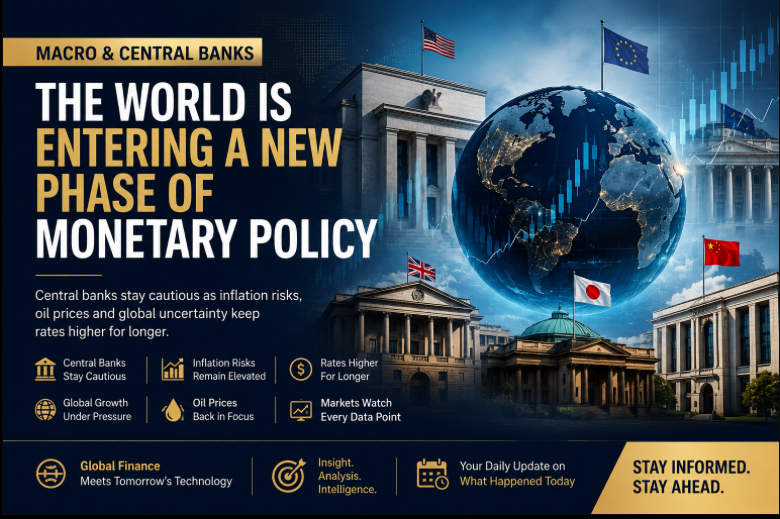
Macro & Central Banks: The World Is Entering a New Phase of Monetary Policy
Published: August 2026
By: Akinyele Oluwale & Co. Investment Ltd.
Executive Summary
The global macroeconomic landscape is becoming increasingly complex. While inflation has eased from the highs seen over the past few years, a fresh wave of uncertainty driven by higher energy prices, geopolitical tensions, and resilient labour markets is forcing central banks to remain cautious.
Rather than rushing into interest rate cuts, policymakers are signalling patience. The U.S. Federal Reserve, European Central Bank (ECB), Bank of England (BoE), Bank of Japan (BoJ), and People's Bank of China (PBOC) are all navigating different economic challenges, but they share one common objective: keeping inflation under control without pushing their economies into recession. (Reuters)
For investors, businesses, and households alike, one message is becoming increasingly clear: higher interest rates may remain with us for longer than many had expected.
A Delicate Balancing Act
Over the past three years, central banks have fought aggressively against inflation by raising interest rates.
That strategy worked.
Inflation has slowed significantly across many developed economies.
But the battle isn't over.
Fresh geopolitical risks, rising oil prices, supply chain pressures, and strong consumer spending continue to threaten inflation's downward path. Rather than declaring victory, policymakers are choosing caution. (Reuters)
This explains why financial markets have become increasingly sensitive to every economic report, every speech from a central banker, and every inflation release.
Federal Reserve: Waiting for More Evidence
The U.S. Federal Reserve remains the most influential central bank in the world.
At its latest meeting, policymakers left interest rates unchanged, but markets were left with very little guidance about what comes next. Investors are now closely watching employment data, inflation reports, and consumer spending to determine whether another rate increase could still happen later this year. (Reuters)
The Fed finds itself in a difficult position.
Inflation has moderated, yet it has not fully returned to target.
Meanwhile, the U.S. labour market continues to show resilience, making it harder for the Fed to confidently begin an easing cycle.
For now, policymakers appear comfortable waiting for clearer evidence before making their next move.
Europe: Inflation Risks Haven't Disappeared
The European Central Bank has also adopted a cautious tone.
Although parts of the eurozone economy have shown surprising resilience, inflation remains vulnerable to renewed increases, particularly from higher energy prices and geopolitical uncertainty. The ECB has indicated it remains prepared to tighten policy further if inflation proves more persistent than expected. (Reuters)
This reflects a broader shift among central banks.
Rather than focusing only on current inflation, policymakers are increasingly concerned about preventing a second wave of price increases.
United Kingdom: Holding Rates Despite Pressure
The Bank of England chose to keep interest rates unchanged despite concerns that higher oil prices could eventually feed into broader inflation.
Not everyone on the Monetary Policy Committee agreed.
Several members argued that additional tightening might still be necessary if energy costs continue to rise and begin affecting wages and business pricing.
For now, however, the Bank has opted for patience while acknowledging that risks remain elevated. (The Guardian)
China Takes a Different Approach
Unlike most Western economies, China's biggest concern isn't excessive inflation.
Instead, policymakers are focused on supporting economic growth.
The People's Bank of China recently pledged to adjust monetary policy tools when necessary, maintain ample liquidity, support infrastructure investment, expand offshore yuan financing, and continue opening China's financial markets. (Reuters)
These measures come as China's economy faces slower growth and policymakers work to stabilise domestic demand while strengthening the yuan's international role.
Rather than fighting inflation, Beijing is attempting to stimulate economic activity without creating financial instability.
Japan Remains Unique
Japan continues to follow its own monetary path.
While inflation has finally returned after years of deflation, the Bank of Japan remains cautious about tightening policy too quickly.
Officials appear willing to move gradually while monitoring wage growth, domestic demand, and inflation expectations. (Reuters)
Japan's approach serves as a reminder that each central bank faces different structural challenges, even within an interconnected global economy.
Why Oil Prices Matter Again
One of the biggest macro themes returning to investors' radar is energy.
Higher oil prices increase transportation, manufacturing, and production costs across almost every industry.
If businesses pass those higher costs on to consumers, inflation can begin rising again.
That creates a difficult dilemma for central banks.
Lowering interest rates could stimulate growth but may also reignite inflation.
Keeping rates high helps control prices but risks slowing economic activity.
This balancing act explains why many policymakers are choosing to wait rather than act aggressively. (Reuters)
Markets Are Watching Every Data Release
The days when markets reacted only to interest-rate decisions are gone.
Today, investors closely analyse:
Each release has the potential to reshape expectations about future monetary policy.
That explains why financial markets have become increasingly volatile around major economic announcements. (The Wall Street Journal)
What This Means for Investors
The investment environment is changing.
For much of the past decade, investors became accustomed to ultra-low interest rates and abundant liquidity.
Today's environment is very different.
Capital is more expensive.
Borrowing costs remain elevated.
Valuations are becoming more sensitive to earnings quality and cash flow.
This shift is encouraging investors to become more selective, focusing on financially strong businesses, resilient sectors, and long-term structural trends such as artificial intelligence, digital infrastructure, and productivity-enhancing technologies.
Meanwhile, fixed-income investments are once again becoming attractive after years of historically low yields.
Looking Ahead
The months ahead are likely to remain data-dependent.
Central banks are no longer providing detailed forward guidance. Instead, they are responding to incoming economic data meeting by meeting.
Investors should expect policy decisions to remain flexible as officials balance inflation risks against slowing economic growth.
For now, the global economy appears to be entering a period where caution not urgency defines monetary policy.
That may not generate dramatic headlines every week, but it reflects a broader reality: the world's most powerful central banks are trying to secure a soft landing after one of the most aggressive tightening cycles in modern history.
Whether they succeed will shape financial markets, borrowing costs, investment returns, and economic growth for years to come.
Key Takeaways