

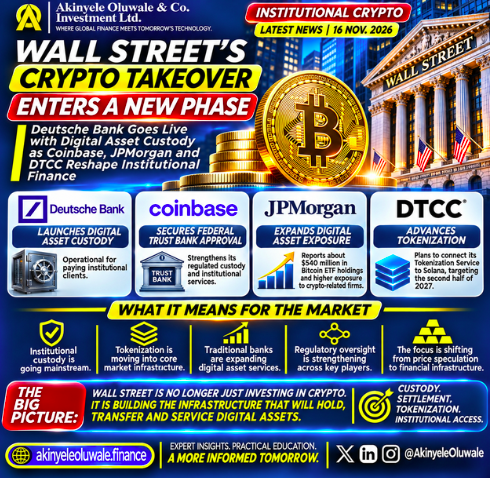
Bitcoin's recent market decline has not stopped major financial institutions from expanding digital-asset custody, regulated investment exposure and blockchain-based securities infrastructure. The real transformation is moving beyond cryptocurrency prices toward the institutions that control custody, settlement, compliance and access to financial markets.
Published: Monday, 16 November 2026
Category: Institutional Crypto
By: Akinyele Oluwale & Co. Investment Ltd.
Editorial focus: Institutional Custody | Banking | Crypto ETFs | Tokenization | Financial Regulation | Market Infrastructure
Other developments reinforced the direction of the market. On 9 November, Coinbase announced that it had secured final approval for its national trust bank charter, strengthening the federal regulatory framework around its institutional custody activities. On 12 November, the Depository Trust & Clearing Corporation (DTCC) announced plans to connect its Tokenization Service to the Solana blockchain, targeting the second half of 2027. Meanwhile, a 13 November report examining JPMorgan's disclosed holdings highlighted exposure to Bitcoin-related investment products and publicly traded digital-asset companies. These developments point toward a structural change.
Traditional financial institutions are no longer evaluating cryptocurrencies solely as speculative assets. They are increasingly building or participating in the infrastructure required to hold, administer, transfer and service digital assets. However, institutional adoption should not be confused with guaranteed investment returns.
Our central assessment is that institutional crypto is moving from a market-access story to a financial-infrastructure story. The institutions controlling custody, compliance and settlement may become as important as the digital assets themselves.
For many years, the relationship between cryptocurrency and traditional banking was characterised by uncertainty. Banks were concerned about regulatory obligations, financial crime, cybersecurity, market volatility and the operational risks associated with holding digital assets. Cryptocurrency companies, meanwhile, often developed services outside conventional banking infrastructure. That relationship is changing. Major financial institutions increasingly recognise that digital assets require many of the same supporting services as traditional securities. These include custody, transaction controls, client reporting, regulatory compliance, settlement and asset servicing. Consider a hypothetical institutional investor holding $100 million in digital assets.
The investor's concerns extend far beyond the market price of Bitcoin or Ethereum. The institution must determine where the assets are held, who controls the private keys, how transactions are authorised and what happens if a service provider experiences an operational failure. It must also establish how holdings are recorded, valued and reported. For regulated financial institutions, these requirements are fundamental. A digital asset cannot become a dependable institutional financial product merely because it can be transferred across a blockchain. It must operate within a framework that supports accountability, security and legal certainty. This explains why custody is becoming a major competitive priority.
The next phase of institutional cryptocurrency adoption may be shaped less by which institution makes the largest Bitcoin purchase and more by which institutions build the most dependable financial infrastructure.
On 11 November 2026, Deutsche Bank announced that its digital-asset custody service was operational for paying clients. The launch represents a significant development in the relationship between traditional banking and cryptocurrency infrastructure. Deutsche Bank is one of Europe's major banking institutions. Its entry into operational digital-asset custody demonstrates growing institutional willingness to provide services supporting digital assets. The service is reported to support Bitcoin, Ethereum and selected stablecoins for institutional and corporate clients. However, the significance should be interpreted carefully. A custody service does not necessarily mean that the bank is making a directional investment in Bitcoin. It also does not establish that the bank expects cryptocurrency prices to rise. Custody is a financial service.
Its purpose is to provide arrangements for holding and administering assets on behalf of clients. A bank may generate commercial value from custody services through fees and related client relationships, subject to its business model and operating costs. This is fundamentally different from purchasing cryptocurrency for speculative investment. For institutional clients, custody services may provide access to established banking relationships, governance arrangements and compliance processes. However, the quality of those services must still be evaluated. Investors and institutions should examine the legal structure of custody, segregation of client assets, cybersecurity arrangements and responsibility for operational failures.
Institutional implication: Digital-asset custody is moving further into the operational activities of established banks.
On 9 November, Coinbase announced that it had obtained final approval for a national trust bank charter. The development is significant because it strengthens the federal regulatory structure surrounding its institutional custody activities. The charter provides a framework for custody and related trust services under the supervision of the Office of the Comptroller of the Currency. However, a national trust bank is not equivalent to a conventional commercial bank offering every category of banking service. The approved structure does not automatically authorise ordinary retail deposit-taking or traditional commercial lending. This distinction matters. Financial institutions operate under different legal structures, and those structures determine the services they may provide. For Coinbase, the development represents progress in connecting digital-asset custody with established regulatory supervision. For institutional clients, federal oversight may provide greater clarity concerning the applicable supervisory framework.
Nevertheless, regulatory approval does not eliminate operational risk. Custody providers must still maintain effective security, internal controls and financial governance. Nor should the approval be interpreted as a government guarantee of cryptocurrency prices. Institutional implication: Regulatory status is becoming an important competitive factor in institutional digital-asset custody.
On 13 November, reporting on JPMorgan's regulatory disclosures highlighted increased exposure to several Bitcoin-related financial instruments. The reported holdings included approximately $540 million in BlackRock's Bitcoin ETF and an increase of around 36% in reported Strategy share holdings. The bank also disclosed positions in Coinbase and several publicly traded Bitcoin mining companies. These developments illustrate the growing connections between traditional securities markets and digital-asset businesses. However, an important distinction must be maintained. A regulatory filing showing securities held by a financial institution does not automatically establish that every position represents a direct investment conviction by the bank's management. Some positions may relate to client activity, trading, hedging or other business arrangements. The filing alone may not establish the economic purpose of every holding. Similarly, exposure to a Bitcoin ETF is not identical to directly holding Bitcoin. An ETF provides exposure through a regulated investment product with its own legal and operational structure. Shares in a cryptocurrency-related company introduce another category of risk. Their performance may depend on management decisions, financing arrangements, operating costs and broader equity-market conditions. Institutional implication: Traditional financial institutions are becoming increasingly connected to digital assets through securities-market products, even when they are not directly purchasing cryptocurrencies for their own long-term portfolios.
On 12 November, DTCC announced plans to connect its Tokenization Service with the Solana blockchain. The proposed integration is expected to make tokenized representations of eligible securities held through the Depository Trust Company available on Solana in the second half of 2027. This is an important infrastructure development. DTCC plays a central role in traditional securities-market operations, including post-trade processing and asset servicing. Its involvement demonstrates that tokenization is becoming increasingly relevant to established financial-market infrastructure. The objective is not simply to create digital tokens.
It is to explore how eligible financial assets can be represented and administered through approved digital systems. Potential applications include improved collateral mobility, operational efficiency and connectivity between traditional financial infrastructure and blockchain networks. However, the planned Solana integration has not yet been completed. DTCC's Tokenization Service launched in October 2026, but the specific Solana integration is scheduled for a later phase. The distinction between a live service and a planned integration is essential. It would also be incorrect to assume that DTCC's existing securities-processing volumes will automatically migrate onto Solana. The eventual commercial impact will depend on eligible assets, participating institutions and actual transaction activity. Institutional implication: Traditional securities infrastructure providers are increasingly developing systems that connect regulated financial assets with blockchain technology.
The latest institutional developments occurred during a difficult period for cryptocurrency markets. Bitcoin fell below $70,000 during the week ended 14 November. At the same time, U.S. spot Bitcoin ETFs experienced significant withdrawals. Data reported through 13 November indicated approximately $2.3 billion in net outflows from U.S. spot Bitcoin ETFs during the month to that point. This creates an apparent contradiction. Major financial institutions are expanding digital-asset infrastructure while investors are reducing exposure through regulated cryptocurrency investment products. However, these developments are not necessarily inconsistent. Infrastructure investment and portfolio allocation operate over different time horizons. A bank may invest in custody technology because it expects demand for digital-asset services over several years. An institutional investor may reduce Bitcoin exposure because of near-term liquidity needs, portfolio rebalancing or changing macroeconomic expectations. The same financial institution may also operate several business lines with different objectives. It might provide cryptocurrency custody services while other divisions reduce market exposure. These activities should not be interpreted as a single institutional investment strategy. Institutional implication: Digital-asset infrastructure can expand even when institutional investment flows weaken.
The latest developments suggest that the cryptocurrency industry is becoming more closely connected to traditional financial institutions. This does not necessarily mean that cryptocurrencies are replacing banks. Instead, banks and other established financial institutions are developing services that incorporate digital assets and blockchain technology. The emerging structure involves several layers. Custody: Institutions provide arrangements for safeguarding and administering digital assets. Investment access: Regulated investment products allow investors to obtain exposure to selected digital assets. Settlement: Financial institutions examine how digital assets can support payment and securities transactions. Tokenization: Traditional financial assets are represented digitally through approved infrastructure. Compliance: Service providers operate within applicable regulatory and supervisory frameworks. Asset servicing: Institutions manage the administrative processes associated with financial assets. These functions are familiar within conventional finance. What is changing is the technology used to support them. The long-term significance of institutional crypto may therefore be less about creating an entirely separate financial system and more about incorporating blockchain capabilities into established financial services.
The latest developments have important implications for African financial markets. Nigeria has a substantial digital-finance ecosystem and growing interest in blockchain-based financial services. However, institutional cryptocurrency adoption requires more than technological enthusiasm. Banks and financial service providers must understand the applicable regulatory environment. They must establish effective custody arrangements, customer identification procedures, cybersecurity controls and transaction-monitoring systems. The Central Bank of Nigeria's November 2026 framework for non-security virtual assets illustrates the growing emphasis on regulatory supervision. The framework establishes requirements for specified categories of virtual-asset service providers, including stablecoin issuers. For Nigerian financial institutions, the strategic opportunity may involve developing compliant digital payment, custody and asset-servicing infrastructure.
However, foreign institutional announcements should not be interpreted as evidence that identical services are already authorised or commercially available in Nigeria. Local implementation depends on applicable laws, regulatory approvals and market conditions. Our assessment is that Nigeria's institutional digital-finance opportunity will depend on building credible financial infrastructure, not merely encouraging greater cryptocurrency trading activity.
At Akinyele Oluwale & Co. Investment Ltd., we believe the most important institutional cryptocurrency development is the growing competition for financial infrastructure. Deutsche Bank's custody launch demonstrates the expanding role of established banks. Coinbase's trust bank approval highlights the importance of regulatory positioning. JPMorgan's disclosed securities exposure illustrates the connections between traditional investment markets and digital-asset businesses. DTCC's tokenization strategy demonstrates how blockchain may become part of securities-market infrastructure. Together, these developments point toward a financial industry in which custody, settlement and regulatory credibility are becoming central competitive factors. However, investors must avoid drawing unsupported conclusions. A bank offering cryptocurrency custody does not necessarily mean that the bank expects Bitcoin prices to rise. A financial institution holding cryptocurrency-related securities does not automatically establish a long-term directional investment strategy. A securities infrastructure provider integrating a blockchain does not guarantee investment returns for that network's cryptocurrency. These distinctions are essential. We believe five principles should guide institutional crypto analysis. First, distinguish infrastructure adoption from investment exposure. A bank providing custody is not necessarily taking market risk on the assets it holds. Second, examine regulatory status carefully. Approval for one category of financial service does not automatically authorise every banking activity. Third, evaluate operational readiness. Security, custody arrangements and transaction controls are fundamental. Fourth, assess actual commercial adoption. A live service, a pilot and a future integration represent different stages of development. Fifth, measure economic value independently. Institutional participation does not eliminate valuation risk or guarantee financial returns. Our institutional conclusion is that the digital-asset industry is becoming more integrated with conventional finance, but that integration introduces new responsibilities as well as opportunities.
The next competitive advantage may belong to institutions that combine blockchain capabilities with the trust, legal certainty and operational discipline required in regulated financial markets.
Several developments deserve attention during the remainder of November 2026. Deutsche Bank: Monitor the commercial development of its digital-asset custody service and the scope of institutional participation. Coinbase: Watch how the national trust bank charter affects its custody operations and regulatory structure. JPMorgan: Examine subsequent regulatory disclosures for changes in reported digital-asset-related securities exposure. DTCC: Follow technical and institutional progress toward the planned Solana integration in 2027. Bitcoin ETF flows: Monitor whether institutional withdrawals continue or begin to moderate. Bank custody competition: Watch whether additional major financial institutions launch operational digital-asset custody services. Regulatory developments: Assess changes affecting custody, tokenization, settlement and institutional investment products. Stablecoin integration: Monitor how banks incorporate digital settlement services into corporate finance. Financial stability: Follow interest rates, liquidity conditions and broader market developments affecting institutional risk appetite. These indicators will help distinguish sustained institutional progress from short-term market sentiment.
- Deutsche Bank launched operational digital-asset custody services for paying clients on 11 November 2026.
- Coinbase announced final approval for its national trust bank charter on 9 November.
- The charter supports custody and related trust services but does not automatically authorise conventional retail banking activities.
- JPMorgan's disclosed holdings demonstrate growing connections between traditional securities markets and digital-asset businesses.
- Regulatory holdings disclosures do not necessarily establish a bank's investment intentions.
- DTCC announced plans to connect its Tokenization Service to Solana in the second half of 2027.
- The planned Solana integration is not yet a completed deployment.
- Bitcoin ETF outflows demonstrate that institutional investment demand can weaken even while infrastructure development advances.
- Institutional crypto adoption increasingly involves custody, compliance, settlement and asset servicing.
- Sustainable growth will depend on regulatory credibility, operational reliability and measurable commercial value.
Akinyele Oluwale & Co. Investment Ltd. is an institutional financial intelligence platform focused on global macroeconomics, central banking, institutional cryptocurrency, stablecoins, digital payments, tokenization, real-world assets, artificial intelligence and blockchain technology. Our editorial mission is to explain consequential financial developments through evidence-based research, practical financial education and an institutional perspective. We examine how financial institutions, emerging technologies and regulatory frameworks interact to shape the future of global finance.
The latest developments demonstrate that institutional cryptocurrency adoption is entering a more operational phase. Deutsche Bank is now providing digital-asset custody services. Coinbase has strengthened its federal regulatory position. JPMorgan's securities disclosures highlight the connections between traditional investment markets and digital-asset businesses. DTCC is developing additional blockchain connectivity for tokenized securities. Meanwhile, cryptocurrency markets continue to experience significant volatility. These developments reveal an important distinction. The future of institutional crypto cannot be measured solely through Bitcoin prices or ETF flows. It must also be evaluated through the development of reliable financial infrastructure. For banks, the opportunity lies in providing secure and compliant services. For financial-market infrastructure providers, it lies in improving custody, settlement and asset servicing. For regulators, the challenge is preserving financial stability while supporting responsible innovation and for investors, the lesson is to distinguish technological adoption from investment valuation.
The next phase of institutional crypto will not be defined simply by how much Bitcoin Wall Street owns. It will be defined by how deeply digital assets become integrated into the custody, settlement and operating systems of global finance.
Observe the change. Understand the implications. Position with discipline.
Akinyele Oluwale & Co. Investment Ltd.
Where Global Finance Meets Tomorrow's Technology.
Website: www.akinyeleoluwale.finance
Editorial disclaimer: This article provides general financial education and institutional market analysis. It does not constitute personalised investment advice or a recommendation to purchase or sell any cryptocurrency or financial instrument.