

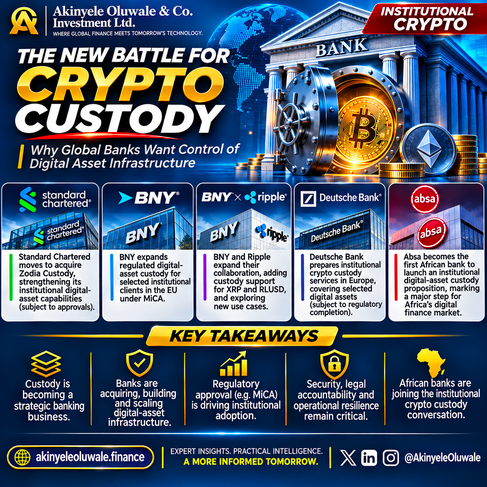
As institutional digital assets move beyond trading, banks and specialist custodians are competing to control the systems that safeguard assets, authorise transactions and connect blockchain networks to regulated financial markets.
Published: November 2, 2026
Category: Institutional Crypto
By: Akinyele Oluwale
The first phase of institutional cryptocurrency adoption was largely about gaining exposure to digital assets. The next phase is increasingly about controlling the infrastructure through which those assets are held, transferred and administered.
That shift creates a strategic question for the global financial industry:
Who will become the trusted custodian of digital finance—the established banks, specialist cryptocurrency companies or a combination of both?
Unlike the earlier article examining DTCC's tokenization launch and institutional adoption more broadly, this analysis focuses on a different issue: the growing competition for custody, client relationships and operational control.
For financial institutions, custody is not merely a technical service. It is a foundation of client trust, asset protection, regulatory accountability and long-term commercial relationships.
A significant transformation is taking place in institutional cryptocurrency markets. The competition is no longer limited to which financial institution offers Bitcoin exposure or launches the next digital-asset investment product. A more consequential contest is emerging over who will safeguard digital assets, control institutional client relationships and provide the infrastructure connecting traditional finance with blockchain networks.
Recent developments make this shift increasingly visible.
On October 21, 2026, Standard Chartered announced definitive agreements to acquire Zodia Custody, subject to regulatory approvals and customary closing conditions. The proposed transaction would consolidate specialist digital-asset custody capabilities within the bank's broader securities-services business.
On October 8, BNY announced the expansion of its Digital Asset Custody platform for selected institutional clients in the European Union under the Markets in Crypto-Assets Regulation, commonly known as MiCA.
On October 27, BNY and Ripple expanded their collaboration, with BNY adding custody support for XRP and Ripple's RLUSD stablecoin.
Meanwhile, Deutsche Bank has outlined plans to launch institutional digital-asset custody services in Europe, subject to completion of the applicable regulatory process.
The transformation is not confined to Europe or the United States. In September, South Africa's Absa announced the launch of an institutional digital-asset custody proposition, describing itself as the first African bank to introduce such a regulated offering.
These announcements point toward an important development: digital-asset custody is becoming a strategic financial-services business rather than merely a supporting function for cryptocurrency trading.
However, institutional custody is not automatically risk-free.
Banks and specialist providers must still address cybersecurity, private-key protection, legal ownership, operational resilience, counterparty exposure and the possibility of asset losses.
For investors and financial executives, the question is not simply which institution offers custody.
It is whether that institution can demonstrate reliable asset protection, clear legal accountability and sustainable economic value.
To understand the significance of this development, consider how conventional financial institutions safeguard securities.
When an institutional investor purchases shares or government bonds, those assets are generally held and administered through established custody arrangements.
The custodian may maintain ownership records, facilitate settlement, process corporate actions and provide reporting.
These activities form an essential part of financial-market infrastructure.
Digital assets create additional operational requirements.
A cryptocurrency may be controlled through cryptographic credentials known as private keys. If these credentials are compromised or lost, the consequences can be severe.
For a financial institution managing assets on behalf of clients, protecting those credentials becomes a major responsibility but institutional custody goes beyond technical key management.
It must also establish who owns the assets, who can authorise transfers, what happens during a system failure and how client holdings are protected if a service provider experiences financial difficulties.
This creates a business opportunity for banks and specialist custodians.
Institutional investors may prefer custody arrangements that integrate digital assets with established financial controls, reporting and compliance systems.
However, a familiar banking name does not automatically guarantee that every digital-asset product enjoys the same legal protection as a conventional deposit.
That distinction is essential.
Institutional custody is valuable because it can reduce certain operational burdens not because it eliminates every financial or technological risk.
On October 21, 2026, Standard Chartered announced that it had entered into definitive agreements to acquire Zodia Custody.
Under the proposed transaction, a Standard Chartered entity would acquire 100% of Zodia Custody Limited, the parent of regulated operating entities across several international financial centres.
The acquisition remains subject to regulatory approvals and customary closing conditions.
This is a particularly important development because it illustrates a strategic choice available to traditional banks.
Rather than building every digital-asset capability internally, a bank can seek to acquire specialist infrastructure and integrate it into its existing financial-services operations.
Standard Chartered indicated that the transaction would strengthen its institutional digital-asset capabilities and support a unified offering covering traditional and digital securities services.
The business logic is understandable.
Banks already maintain relationships with institutional clients requiring custody, settlement and securities administration.
Adding digital-asset capabilities may allow them to serve a broader range of those clients' needs.
However, an acquisition announcement is not proof of successful integration.
The economic benefits will depend on regulatory completion, operational compatibility, client adoption and the bank's ability to manage the combined business effectively.
The lesson: Institutional crypto custody is becoming important enough for established banks to pursue strategic acquisitions.
On October 8, BNY announced the expansion of its Digital Asset Custody platform for selected institutions in the European Union under MiCA.
The announcement followed the inclusion of BNY's European banking entity in the relevant European regulatory register in July 2026.
This development is significant because regulatory authorisation is an important requirement for financial institutions seeking to provide digital-asset services.
Institutional clients generally need clarity regarding the legal and supervisory arrangements governing their service providers.
MiCA provides a regulatory framework for specified crypto-asset activities in the European Union.
However, regulatory status should not be interpreted as a guarantee against all possible losses.
A regulated custody provider may still face operational incidents, cyber threats and risks involving external infrastructure.
The practical significance of BNY's expansion is that selected institutional clients can access digital-asset custody through an established financial-services provider operating within a defined European regulatory framework.
The lesson: Regulatory integration is becoming a competitive factor in institutional digital finance.
On October 27, BNY and Ripple announced an expanded collaboration involving institutional custody and the exploration of additional blockchain-based financial applications.
BNY confirmed that its Digital Asset Custody platform supports XRP and RLUSD.
The relationship builds on BNY's role as a reserve custodian for RLUSD and its existing connection with Ripple Prime.
This arrangement demonstrates how different parts of digital-asset infrastructure can become interconnected.
A stablecoin issuer requires arrangements for managing the assets supporting its token.
Institutional investors require secure systems for holding and transferring digital assets.
Financial institutions may also explore how those assets can be used in payment and financing workflows.
However, the distinction between custody and investment performance remains important.
A bank's decision to support a particular token does not establish that the token's market price will increase.
Custody support may improve access for eligible clients, but price performance depends on numerous additional factors.
Similarly, BNY and Ripple's exploration of tokenized trade finance should not be confused with evidence of widespread commercial adoption.
The lesson: Custody is becoming a gateway to broader institutional digital-asset services.
Deutsche Bank announced in September that it planned to launch a digital-asset custody solution for institutional and corporate clients in Europe.
The proposed service includes selected cryptocurrencies and stablecoins, with tokenized financial instruments also included in its development roadmap.
The bank described several security arrangements, including hardware-based protection, segregation of responsibilities, multiple approvals and separate storage environments.
These controls reflect an important principle of financial risk management.
No single individual or system should necessarily have unrestricted control over institutional assets.
Segregation of duties can reduce the risk of unauthorised transactions.
Multiple approvals can strengthen transaction oversight.
Backup and recovery arrangements can support operational continuity.
Nevertheless, such controls reduce risks rather than eliminate them.
Deutsche Bank has also made clear that the planned service remains subject to completion of the applicable regulatory process.
Therefore, the announcement should be classified as a planned institutional service, not an unconditional confirmation of full commercial availability.
The lesson: Traditional banks are seeking to adapt established governance practices to digital-asset custody.
On September 29, Absa announced that it had secured regulatory approval for an institutional digital-asset custody offering in South Africa.
The bank described the service as an institutional-grade proposition for large business and institutional clients.
This development deserves attention across African financial markets.
Digital-asset infrastructure is not exclusively a European or American financial-services issue.
African banks, investment institutions and regulators are also examining how digital assets may fit into regulated financial activities.
For Nigeria, the implications are particularly relevant.
Banks and other financial institutions need to understand the distinction between cryptocurrency trading, digital-asset custody, stablecoin payments and tokenized financial instruments.
These activities can involve different legal obligations, business models and risk exposures.
However, developments in South Africa should not be interpreted as automatic authorisation for equivalent activities in Nigeria.
Nigerian institutions must evaluate applicable domestic regulatory requirements before introducing comparable services.
The lesson: African financial institutions need to understand institutional digital assets, but adoption must remain grounded in local legal and commercial realities.
The emerging custody competition reflects a broader question about the structure of digital finance.
Who will control the relationship between institutional investors and their digital assets?
Several business models are possible.
Traditional banks may offer custody through their existing securities-services divisions.
Specialist digital-asset companies may provide dedicated infrastructure.
Banks may also acquire or partner with specialist providers.
Each approach involves advantages and trade-offs.
Traditional banks may benefit from established client relationships, governance processes and experience administering financial assets.
Specialist providers may possess deeper technical expertise in blockchain systems and digital-asset operations.
Partnerships may combine these capabilities, but they can also introduce additional third-party dependencies.
The eventual structure of the market will depend on commercial performance, regulation and client preferences.
Importantly, custody can influence other financial activities.
An institution that safeguards assets may also be positioned to provide reporting, settlement support, collateral services and related financial administration.
That makes custody commercially significant.
However, financial institutions must manage potential conflicts of interest, concentration risks and dependencies between different service providers.
The objective should not be to centralise control without adequate safeguards.
It should be to create reliable systems through which institutional clients can manage assets efficiently and securely.
Digital-asset custody may create additional service opportunities for banks.
Potential revenue could arise from safekeeping, administration, transfers and related institutional services.
However, the business also requires investment in technology, cybersecurity, compliance and specialist personnel.
Profitability cannot be assumed simply because demand exists.
Specialist providers may face stronger competition from established banks.
At the same time, partnerships and acquisitions could create opportunities for specialist firms whose technology meets institutional requirements.
Their commercial value will depend on the reliability, scalability and security of their services.
Greater custody choice may improve access to digital-asset infrastructure.
But investors should continue examining asset segregation, legal rights, recovery arrangements, service-provider dependencies and contractual responsibilities.
Institutional custody may support stablecoin reserve administration and related operational services.
Nevertheless, reserve quality, redemption rights and governance must be assessed separately from custody arrangements.
Institutional custody expansion may increase opportunities for selected blockchain infrastructure.
However, increased institutional usage does not automatically guarantee that a network's associated cryptocurrency will appreciate.
The connection between usage, fees, token economics and market valuation must be evaluated independently.
African banks may find opportunities in institutional custody and related digital-finance infrastructure.
But these opportunities must be balanced against capital requirements, technology costs, cybersecurity obligations and domestic regulation.
The appropriate approach is to assess business value before committing resources.
At Akinyele Oluwale & Co. Investment Ltd., our assessment is that institutional digital-asset custody is becoming a strategically important segment of financial services.
The significance of Standard Chartered's proposed acquisition of Zodia Custody is not merely that another major bank is participating in cryptocurrency.
It is that the bank is seeking greater control over infrastructure supporting institutional digital-asset services.
BNY's European expansion demonstrates the importance of operating within an established regulatory framework.
Deutsche Bank's planned service illustrates how traditional banks are incorporating digital-asset capabilities into their broader institutional offerings.
Absa's development shows that this transformation is extending into African financial markets.
Taken together, these announcements suggest that the competition is moving beyond who can provide access to digital assets.
The more important question is who can deliver dependable custody, efficient administration and trusted financial infrastructure.
However, the industry should avoid equating institutional participation with guaranteed safety.
A custody service can be regulated and still face operational risks.
A major bank can possess substantial financial resources and still encounter cybersecurity challenges.
A digital asset can be held securely and still experience significant market-price declines.
These distinctions are essential for responsible financial analysis.
Our editorial position is that institutional crypto custody should be judged by the strength of its controls, the clarity of its legal protections and the economic value it delivers not by the prestige of the institution announcing it.
Several developments deserve attention as the custody market evolves.
Standard Chartered and Zodia Custody: Monitor regulatory approvals, transaction completion and the operational integration of the proposed acquisition.
BNY's European expansion: Watch for evidence of institutional adoption, service growth and the practical performance of its custody platform.
BNY and Ripple: Follow further announcements concerning custody capabilities and whether explored applications develop into commercial services.
Deutsche Bank: Monitor regulatory completion, the timing of client onboarding and the final scope of supported digital assets.
African market developments: Observe how Absa's institutional custody service develops and whether other African financial institutions announce comparable regulated offerings.
Cybersecurity: Evaluate whether providers demonstrate effective controls, independent assurance and reliable operational recovery processes.
Client protection: Pay attention to contractual terms, asset segregation, insolvency treatment and the legal rights of institutional clients.
Commercial economics: Assess whether custody businesses can generate sustainable revenue after accounting for compliance, technology and security costs.
Institutional cryptocurrency custody is becoming a strategically important financial-services business.
Standard Chartered announced definitive agreements to acquire Zodia Custody, subject to regulatory approvals and closing conditions.
BNY expanded regulated digital-asset custody services for selected institutions in the European Union.
BNY and Ripple expanded their relationship, including custody support for XRP and RLUSD.
Deutsche Bank is preparing an institutional custody offering, subject to regulatory completion.
Absa's institutional custody development demonstrates growing interest in digital-asset infrastructure within African financial markets.
Banks may use acquisitions, partnerships or internal development to build custody capabilities.
Institutional custody involves governance, legal accountability and operational resilience not simply protecting private keys.
Regulated custody does not eliminate cryptocurrency price volatility, cybersecurity risk or all forms of counterparty exposure.
Long-term success will depend on security, client trust, regulatory compliance and sustainable commercial value.
Akinyele Oluwale & Co. Investment Ltd. is a financial intelligence platform providing research and analysis on institutional cryptocurrency, digital assets, blockchain technology, stablecoins, tokenization, artificial intelligence, central banking and global financial markets.
Our editorial approach combines financial analysis, practical education and an institutional perspective.
We aim to help investors, financial professionals, business executives and policymakers understand emerging developments and assess their implications with discipline.
The latest institutional cryptocurrency developments reveal an increasingly important contest for control of digital-asset custody infrastructure.
Traditional banks are expanding their capabilities.
Specialist custodians are becoming strategic partners and acquisition targets.
Regulatory frameworks are influencing how services are developed and offered.
And institutional clients are demanding arrangements that combine technological efficiency with established financial safeguards.
The implications extend well beyond cryptocurrency trading.
Custody may become one of the foundations supporting future tokenized securities, digital payments and blockchain-based financial services.
But the winners will not necessarily be the institutions with the largest announcements or the broadest token listings.
The institutions that succeed will be those capable of protecting client assets, meeting regulatory obligations and delivering dependable financial services at sustainable cost.
That is the real institutional crypto competition.
Observe the change. Understand the implications. Position with discipline.
Akinyele Oluwale & Co. Investment Ltd.
Where Global Finance Meets Tomorrow's Technology.Website: akinyeleoluwale.finance