

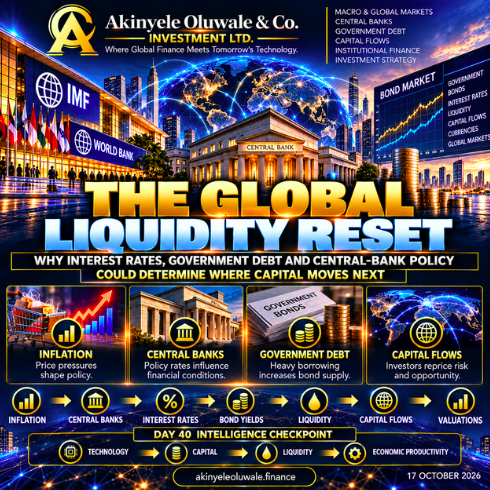
For more than a decade, global investors became accustomed to an extraordinary financial environment.
Interest rates were exceptionally low.
Capital was relatively inexpensive.
Governments could borrow cheaply.
Companies could finance expansion at attractive rates.
Investors searching for higher returns moved aggressively into equities, technology, property and other risk assets.
That environment has changed.
Inflation has returned as a major policy challenge.
Government borrowing requirements have increased.
Bond yields have risen.
Artificial-intelligence infrastructure is creating enormous additional demand for capital.
And central banks are confronting a difficult question:
For investors, however, another question may be even more important:
The answer cannot be determined by policy rates alone.
A central bank can reduce its official interest rate while long-term government bond yields remain elevated.
Governments can continue issuing large quantities of debt.
Banks can maintain strict lending standards.
And investors can continue demanding high returns for providing capital.
This means:
The wider framework is:
Understanding this chain may be essential to understanding the next phase of global markets.
The global financial system may be undergoing a structural change in the price and availability of capital.
During the years following the global financial crisis, extraordinarily low interest rates supported borrowing and asset valuations.
Today, several forces are operating differently.
Inflation remains important.
Government debt is elevated.
Governments require substantial financing.
AI, defence, energy and infrastructure investment are competing for capital.
And investors are demanding greater compensation for holding some long-term debt.
The IMF reported this week that average 10-year government bond yields across the G7 increased by more than one percentage point between February and September 2026, reaching their highest level in nearly two decades. PFM
The investment question is therefore changing from:
When will central banks cut rates?
to:
Those are not necessarily the same event.
Liquidity is one of the most misunderstood concepts in financial markets.
It does not simply mean that there is “money in the system.”
For investors, liquidity is better understood through the availability, cost and willingness of capital to move through the financial system.
Consider a simplified example.
Suppose a central bank reduces its policy rate from 5% to 4.5%.
At first glance, this appears positive for markets.
But imagine that, at the same time:
Government borrowing increases.
Long-term bond yields remain high.
Banks tighten lending standards.
Corporate credit spreads widen.
Investors become more risk-averse.
Would financial conditions necessarily become dramatically easier?
No.
The policy rate has fallen.
But the actual financing environment may remain restrictive.
That distinction matters because asset valuations depend partly on the returns investors can obtain elsewhere.
When relatively safe government bonds offer attractive yields, investors may demand greater expected returns before accepting the additional risks associated with equities, property, private markets and other assets.
The true liquidity question is therefore broader than:
Investors should ask:
The IMF's October 2026 Global Financial Stability Report says financial markets have remained surprisingly resilient.
But it explicitly warns that resilience should not be confused with safety.
One major risk identified by the Fund is a sharp increase in sovereign bond yields driven by inflation pressures, fiscal imbalances and heavy issuance of government and private-sector debt. International Monetary Fund
Why does this matter?
Government bond yields influence borrowing costs throughout financial markets.
They affect:
Mortgages.
Corporate bonds.
Business loans.
Infrastructure financing.
Equity valuations.
Government interest costs.
And international capital flows.
The sovereign bond market is therefore not a side story.
Government borrowing has become another important part of the liquidity equation.
The IMF's April 2026 Fiscal Monitor estimated global public debt at just under 94% of global GDP in 2025, with debt projected to reach approximately 100% by 2029. International Monetary Fund
This week, the IMF again called for governments to address deficits and debt as borrowing costs rise. Reuters
The mechanism matters.
Governments finance deficits partly by issuing bonds.
When government borrowing increases substantially, more bonds must be absorbed by investors.
Those bonds compete with other investments for capital.
The relationship becomes:
This does not mean government borrowing automatically causes bond yields to rise.
Inflation, monetary policy, economic growth, investor demand and global risk sentiment also matter.
But large financing requirements can become increasingly important when markets are already sensitive to inflation and debt sustainability.
Yesterday's Day 39 analysis examined the financing behind the AI boom.
That issue also belongs inside today's liquidity story.
AI requires enormous investment in:
Data centres.
Semiconductors.
Electricity generation.
Transmission infrastructure.
Cooling systems.
And telecommunications.
Central bankers meeting in Bangkok have been examining whether this investment boom is increasing demand for capital before its longer-term productivity benefits fully materialise. Reuters reports that this dynamic is contributing to debate about whether interest rates may remain structurally higher than investors became accustomed to during the previous era of cheap money. Reuters
This creates competition for capital:
When many sectors simultaneously require substantial financing, the price of capital becomes increasingly important.
Central banks cannot focus solely on economic growth.
Their mandates generally require significant attention to price stability.
If inflation remains persistent, policymakers may be reluctant to reduce interest rates aggressively.
The current environment is complicated further by energy costs, geopolitical uncertainty and large investment requirements.
This means monetary policy may remain restrictive even when parts of the economy would benefit from cheaper financing.
The relationship is:
But again, monetary policy is only one component of financial conditions.
The IMF reports that long-term sovereign yields have increased substantially across several major economies.
Between February and September, average G7 10-year government bond yields rose by more than one percentage point. PFM
That matters because long-term yields incorporate expectations about several factors:
Future inflation.
Future policy rates.
Economic growth.
Government borrowing.
Fiscal credibility.
And the compensation investors require for holding long-duration bonds.
This means bond markets can remain restrictive even if central banks eventually begin reducing short-term rates.
The global liquidity environment can be understood through two interconnected forces.
The first begins with inflation.
When inflation rises substantially, central banks may increase interest rates.
Higher rates generally make borrowing more expensive.
Credit growth can slow.
Economic demand can moderate.
Asset valuations may face pressure.
When inflation declines sustainably, central banks may eventually have more room to ease policy.
But this is only half the story.
The second begins with government finances.
Governments must finance spending that exceeds revenue.
One mechanism is bond issuance.
When borrowing requirements are large, investors must absorb substantial debt supply.
If investors demand greater compensation, yields can rise.
That can increase government interest costs.
The cycle can become:
This is why fiscal and monetary policy increasingly interact.
Put both forces together:
↓
↓
↓
↓
↓
↓
↓
This framework helps explain why investors should not analyse central-bank decisions in isolation.
Lower financing costs can support equity valuations because future corporate cash flows become more valuable when discounted at lower rates.
But if long-term yields remain high despite policy-rate reductions, valuation support may be weaker than investors expect.
Highly valued growth companies can be particularly sensitive.
Bond markets sit at the centre of the liquidity reset.
Investors must evaluate:
Inflation.
Government borrowing.
Fiscal credibility.
Central-bank policy.
Economic growth.
And term premiums.
Higher yields may attract investors seeking income.
But rising yields can also produce losses for existing holders of longer-duration bonds.
Companies generally borrow at a premium over government yields.
Therefore:
Highly leveraged businesses can become particularly vulnerable.
This was one of the lessons from our Day 39 AI-financing analysis.
Higher interest rates can initially improve some bank lending margins.
But prolonged high rates can also reduce credit demand and increase borrower stress.
The impact is therefore not one-directional.
Global liquidity conditions matter significantly for emerging economies.
When yields in advanced economies become more attractive, international investors may demand higher returns before allocating capital to riskier markets.
This can influence:
Currencies.
Government borrowing costs.
Corporate financing.
Portfolio flows.
And foreign investment.
The IMF has specifically warned that higher global yields can spill over into Asian financial markets. Reuters
The same transmission principle matters more broadly across emerging economies.
For Nigeria, global liquidity conditions matter through several channels.
International borrowing costs.
Foreign portfolio investment.
Exchange-rate dynamics.
Domestic bond yields.
Government debt servicing.
And the financing environment for businesses.
This means developments in major global bond markets can ultimately influence financing conditions much closer to home.
At Akinyele Oluwale & Co. Investment Ltd., we believe investors should stop treating the question:
as though it were the entire investment strategy.
It isn't.
The more important question is:
Consider three possible scenarios.
Scenario A
Central banks reduce rates.
Bond yields decline.
Credit spreads narrow.
Bank lending improves.
Capital flows toward productive investment.
This represents meaningful easing.
Scenario B
Central banks reduce rates.
But government borrowing remains enormous.
Long-term bond yields stay elevated.
Credit remains expensive.
Capital stays selective.
That represents only partial easing.
Scenario C
Inflation remains persistent.
Central banks maintain or increase rates.
Bond yields remain elevated.
Credit conditions tighten.
That represents continued restrictive conditions.
Investors therefore need to monitor the whole financial system, not one policy rate.
The next major market move may depend less on whether interest rates fall and more on whether the overall cost and availability of capital actually improve.
That distinction becomes increasingly important in an economy where governments, AI companies, energy projects and infrastructure developers are simultaneously competing for capital.
Eight indicators deserve attention.
Is inflation moving sustainably toward central-bank objectives?
Are policymakers signalling easing, tightening or prolonged restriction?
Do yields fall alongside policy rates—or remain elevated?
Are fiscal deficits and bond issuance continuing to increase?
Are investors demanding more or less compensation for corporate credit risk?
Are banks becoming more willing to provide credit?
Is money moving toward equities and emerging markets—or toward safer assets?
Are asset prices supported by improving fundamentals, or mainly by expectations of future monetary easing?
Together, these indicators provide a much better picture of liquidity than policy rates alone.
The global investment environment is being reshaped by the price and availability of capital.
Central-bank interest rates remain important.
But they are only one part of the liquidity equation.
Government debt and bond issuance can influence long-term borrowing costs.
Inflation can restrict the ability of central banks to ease policy.
AI, energy and infrastructure investment are creating additional demand for capital.
Elevated sovereign yields can influence corporate borrowing, asset valuations and emerging-market capital flows.
The central framework is:
Do not watch interest rates alone. Watch whether capital itself is becoming cheaper, more available and more willing to move.
Forty days into our intelligence experiment, four forces increasingly connect the themes we have been tracking:
Technology creates new investment opportunities.
Capital finances those opportunities.
Liquidity determines how easily and cheaply capital can move.
Productivity ultimately determines whether the investment creates sustainable economic value.
This is the connection between AI, tokenization, stablecoins, central banks, private capital and global markets.
Different technologies.
Different financial instruments.
But ultimately the same question:
Akinyele Oluwale & Co. Investment Ltd. is a global finance and digital-economy intelligence platform examining developments reshaping financial markets, institutional investment and emerging technologies.
Our intelligence coverage includes:
AI • Blockchain & Technology • Crypto & Digital Assets • Institutional Finance • Stablecoins & Payments • Tokenization & RWAs • Central Banks • Macro & Global Markets
We examine developments through three essential questions:
What changed?
Why does it matter?
What should investors watch next?
Our objective is to connect global financial developments with their implications for investors, businesses and economic decision-makers while promoting informed and disciplined investment thinking.
Akinyele Oluwale & Co. Investment Ltd.
Where Global Finance Meets Tomorrow's Technology.