

Tether Clears Historic KPMG Audit: What the Milestone Means for USDT, Stablecoins and Global Payments
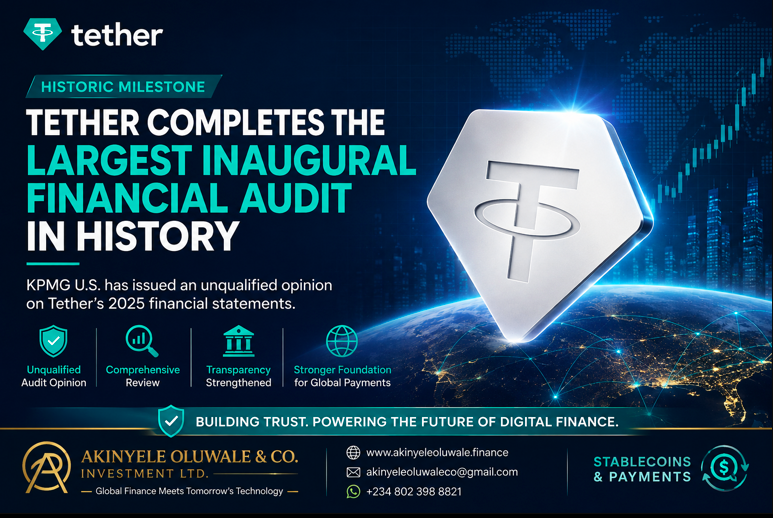
Tether has crossed a transparency threshold the stablecoin industry has waited years to see. KPMG U.S. has issued an unqualified audit opinion on Tether’s 2025 financial statements, moving the company beyond the quarterly reserve attestations that previously defined its disclosure regime. (tether.io)
Published: 13 August 2026
Category: Stablecoins & Payments • USDT • Digital Assets • Institutional Finance
By: Akinyele Oluwale & Co. Investment Ltd.
Executive Summary
Tether announced today that KPMG U.S. has completed its inaugural financial-statement audit and issued an unqualified opinion on its 2025 financial statements—the strongest standard form of audit opinion, indicating the auditor found no material qualifications requiring modification of the opinion. (tether.io)
This matters because Tether has faced years of questions over the transparency of the reserves and financial structure supporting USDT. Until now, the company primarily relied on periodic reserve attestations rather than a comprehensive financial-statement audit.
The audit examined more than reserve balances. According to Tether, KPMG reviewed transactions, systems, ownership records, valuations, counterparties and supporting evidence behind the company's financial statements. (tether.io)
For the stablecoin industry, this isn't merely an accounting event.
It is a credibility event.
What Happened?
Earlier this year, Tether announced that it had engaged a Big Four accounting firm to conduct its first comprehensive financial-statement audit. (tether.io)
We now know the auditor was KPMG U.S.
The process has been completed, covering Tether's 2025 financial statements, with KPMG issuing an unqualified audit opinion. (tether.io)
That distinction is important.
Tether's previous quarterly reserve reports provided independent assurance at specific reporting dates. A financial-statement audit goes considerably further by examining the broader financial reporting environment, underlying transactions and supporting evidence.
For an organisation operating at Tether's scale, that is a major step.
Context / Background
For years, one question repeatedly followed USDT:
“Where is the full audit?”
Tether regularly published third-party reserve attestations, including assurance work performed by BDO Italia. But attestations and financial-statement audits are not identical.
An attestation can provide assurance over specified information such as reserves at a particular reporting date.
A financial-statement audit examines a much broader body of financial information and evidence before the auditor expresses an opinion.
That difference has mattered because USDT has become deeply embedded in global digital-asset markets.
In March, when Tether announced the audit engagement, USDT's market value was approximately $184 billion. (coindesk.com)
At that size, reserve credibility isn't simply a Tether issue.
It is increasingly a financial-system issue for digital assets.
Why It Matters
Stablecoins operate on confidence.
One USDT is designed to maintain a value of approximately one U.S. dollar.
But that promise only works at scale when markets believe the issuer has sufficient assets, liquidity and operational capacity to honour redemptions.
This is why transparency matters so much.
The stronger the independent verification behind a stablecoin issuer, the easier it becomes for:
Institutions to evaluate counterparty risk.
Regulators to assess financial resilience.
Payment companies to consider integration.
Investors to understand reserve quality.
And ultimately, for users to trust the digital dollar they are holding.
Why This Matters for Payments
USDT's significance increasingly extends beyond crypto trading.
Stablecoins are being used for dollar access, remittances, settlement and cross-border transfers in markets where traditional banking can be expensive or difficult to access.
For stablecoins to graduate from crypto infrastructure to mainstream payment infrastructure, however, technology isn't enough.
They need institutional-grade trust.
That requires:
Reliable reserves.
Redemption capability.
Risk management.
Regulatory compliance.
And increasingly, independent financial scrutiny.
Tether's audit addresses one important part of that equation.
Winners and Losers
Potential Winners
Tether: The audit removes one of the longest-running criticisms surrounding the company.
USDT holders: Greater independent scrutiny potentially strengthens confidence in the issuer.
Institutional investors: Better financial information improves counterparty and reserve-risk assessment.
Stablecoin payments: Stronger transparency can support the argument that regulated digital dollars deserve a larger role in mainstream finance.
Potential Pressure
Less-transparent stablecoin issuers: Expectations have just moved higher.
If the world's largest stablecoin issuer can undergo a comprehensive audit, investors and regulators may increasingly ask why smaller issuers cannot provide comparable transparency.
Short-Term Impact
Don't expect USDT suddenly to behave differently because an audit has been completed.
The immediate impact is primarily credibility and institutional perception.
For years, critics could reasonably point to the absence of a comprehensive financial-statement audit.
That argument now has to change.
But an unqualified audit opinion does not mean Tether or USDT carries zero risk.
Audits provide assurance over financial statements for a defined period. They are not permanent guarantees against market, liquidity, regulatory, operational or counterparty risk.
That distinction matters.
Long-Term Impact
The larger consequence may be an escalation in stablecoin transparency standards.
As stablecoins become more integrated into banking, payments and tokenized financial markets, issuers may increasingly be expected to operate with disclosure standards closer to traditional financial institutions.
That means the competitive battleground could shift from:
Who has the largest stablecoin?
to:
Who has the strongest reserves, transparency, liquidity, regulatory structure and distribution network?
That would represent a major maturation of the industry.
Editorial Perspective
This audit matters because stablecoins ultimately sell something more valuable than technology:
Trust.
A blockchain can prove that a token moved from one wallet to another.
It cannot, by itself, prove that the company promising redemption has strong financial statements, appropriate controls or sufficient underlying assets.
That requires traditional financial disciplines.
Accounting.
Auditing.
Governance.
Risk management.
Compliance.
Crypto doesn't eliminate these institutions.
In many cases, maturity brings them back in a stronger form.
The irony is powerful:
The closer stablecoins move toward mainstream finance, the more important old-fashioned financial credibility becomes.
What to Watch Next
The next questions are whether Tether maintains annual audited financial statements, how reserve composition evolves, whether disclosure around counterparties and custodians expands, and how regulators respond.
Also watch Tether's competitors.
The audit could create pressure across the stablecoin sector for stronger and more frequent independent scrutiny.
Investing Lesson
Trust but verify.
Investors should never rely solely on size, reputation or market dominance.
Whether evaluating a stablecoin, bank, company or investment fund, ask:
What backs the promise?
Who independently verifies it?
How liquid are the assets?
What happens under stress?
Transparency does not eliminate risk.
But it makes risk easier to understand.
And intelligent investing begins with understanding what you actually own.
Key Takeaways
Editorial Bottom Line
Tether has answered one of the biggest questions hanging over USDT for years: where is the comprehensive audit?
Now the question changes.
Can Tether turn stronger financial transparency into deeper institutional adoption and make USDT an even more important part of global payment infrastructure?
If it can, 13 August 2026 may be remembered as more than an accounting milestone.
It could mark another step in stablecoins' transition from crypto-market plumbing to mainstream financial infrastructure.
Akinyele Oluwale & Co. Investment Ltd.
Global Finance Meets Tomorrow's Technology.