

Nigeria’s New Tax Regime: What You Need to Know (Finance Act 2025)
At Akinyele Oluwale & Co., we are committed to keeping our clients informed about the latest regulatory changes affecting businesses and individuals in Nigeria.
The Finance Act 2025 represents one of the most significant tax reforms in Nigeria in recent years. Signed into law to simplify the tax system, reduce multiple taxation, and improve ease of doing business, the Act introduces several key changes:
Major Highlights:
Company Income Tax (CIT) reduced to 25% for large companies (from 30%).
Tertiary Education Tax significantly reduced from 2% to 0.5%.
- Strengthened rules against multiple taxation across federal, state, and local governments.
- Expanded scope of Value Added Tax (VAT) on digital services and luxury goods.
- Higher exemption thresholds for Capital Gains Tax and Personal Income Tax.
- Mandatory digital compliance through the new Rev360 platform.
New Tax Portal – Rev360
The Federal Inland Revenue Service (FIRS) has launched Rev360 (www.rev360.gov.ng), a unified digital platform for all federal tax filings and payments. This new system makes tax compliance easier, faster, and more transparent.
Our Advisory
These reforms present both opportunities and compliance requirements for businesses. Early adaptation will help you avoid penalties and optimize your tax position.
By Akinyele Oluwale & Co. Investment Ltd.
Website: www.akinyeleoluwale.finance
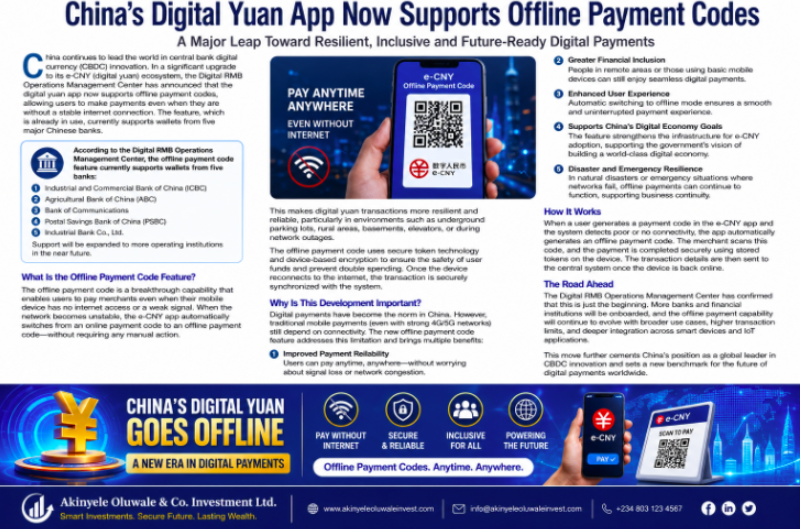
China has once again demonstrated why it remains one of the world's leading innovators in financial technology. In a significant development for the country's Central Bank Digital Currency (CBDC), the Digital Yuan (e-CNY) mobile application now supports offline payment codes, allowing users to complete transactions even when internet connectivity is weak or temporarily unavailable.
The Digital RMB Operations Management Center confirmed that the feature initially supports digital wallets issued by Industrial and Commercial Bank of China (ICBC), Agricultural Bank of China (ABC), Bank of Communications, Postal Savings Bank of China (PSBC), and Industrial Bank Co., Ltd. Support for additional financial institutions is expected to be introduced gradually.
Although mobile payments have become a way of life across China, they have always depended, to varying degrees, on stable internet access. This latest innovation addresses one of the last remaining challenges facing digital payments—maintaining transaction capability during network interruptions.
The introduction of offline payment codes is more than just another software update. It represents another important step toward building a resilient, inclusive, and intelligent digital financial ecosystem that could influence the future of payment systems worldwide.
The Digital Yuan, also known as e-CNY, is China's official Central Bank Digital Currency issued by the People's Bank of China (PBOC). Unlike cryptocurrencies such as Bitcoin or Ethereum, the Digital Yuan is sovereign money backed directly by China's central bank.
Its objectives include:
Since pilot testing began several years ago, millions of Chinese consumers have used the Digital Yuan for purchases ranging from groceries and transportation to utility bills and government services.
Traditionally, QR-code payments require both the merchant and the customer's devices to communicate through the internet before a payment can be authorized.
The newly introduced offline payment code changes that experience.
When the e-CNY application detects that internet connectivity has become unstable or unavailable, it can automatically generate an offline payment code. The merchant scans the code, and the transaction is completed using securely stored payment credentials on the user's device. Once internet access is restored, the transaction information is synchronized with the central payment system.
This seamless transition allows users to continue making payments without manually switching payment modes or worrying about temporary signal loss.
One of the greatest advantages of the offline payment feature is reliability.
Whether a user is inside a subway station, basement parking lot, rural village, elevator, airport terminal, or disaster zone, payment interruptions caused by poor network coverage become significantly less likely.
Consumers gain confidence knowing that their preferred payment method remains available even under less-than-ideal conditions.
Digital payment adoption has transformed commerce, but internet access remains uneven in many regions.
Offline payment capability makes digital currency more practical for:
This contributes to one of the core goals of Central Bank Digital Currencies—making digital finance accessible to more people regardless of location.
Merchants depend on uninterrupted payment systems.
When internet connectivity fails, businesses often lose sales because customers cannot complete transactions.
Offline payment functionality reduces this risk by allowing commerce to continue during temporary communication failures.
Retail stores, restaurants, supermarkets, pharmacies, hospitals, transportation services, and public utilities all benefit from increased payment resilience.
Natural disasters, network outages, cyber incidents, and infrastructure failures can disrupt payment systems.
Offline digital payments offer an additional layer of resilience.
Emergency responders, humanitarian organizations, and affected communities could continue exchanging value even while communication networks are being restored.
This makes offline CBDC functionality strategically important beyond everyday convenience.
Although detailed technical specifications have not been fully disclosed publicly, offline payment systems generally rely on several advanced security technologies:
Each wallet securely verifies the identity of the payment device.
Instead of exposing sensitive banking information, encrypted payment credentials authorize the transaction.
Sensitive payment information is protected within secure hardware components on compatible devices.
Once connectivity returns, completed offline transactions synchronize with the broader payment network.
This layered security approach helps reduce fraud risks while maintaining a smooth customer experience.
The Digital RMB Operations Management Center confirmed that the first rollout supports wallets issued by:
The feature is expected to expand to additional participating banks in future updates.
China continues to lead the world in practical Central Bank Digital Currency implementation.
While many countries are still researching CBDCs, China has moved beyond experimentation into continuous feature enhancement.
This latest development sends a clear signal that future payment systems will prioritize:
Central banks around the world—including those in Europe, Africa, Asia, and the Americas—are closely monitoring China's progress.
African economies are rapidly embracing digital payments.
Countries including Nigeria, Ghana, Kenya, Rwanda, and South Africa continue investing in fintech innovation.
For policymakers across Africa, China's offline payment solution demonstrates how digital currencies can better serve populations where internet connectivity may be inconsistent.
Potential applications include:
Nigeria's own experience with the eNaira illustrates the growing importance of CBDC innovation, though wider adoption will depend on continued improvements in usability, merchant acceptance, and consumer confidence.
Consumers stand to gain several advantages:
For many users, the difference between online and offline payments may become almost invisible as the technology operates automatically in the background.
Businesses may experience:
Retailers that frequently experience poor network coverage may find this especially valuable.
Despite its advantages, offline payment functionality also introduces considerations that require careful management:
Offline transactions may be subject to value limits to reduce risk.
Some functionality may depend on compatible smartphones or secure hardware.
Robust safeguards are essential to prevent double spending and unauthorized transactions.
Merchants must ensure their payment terminals support the latest e-CNY capabilities.
These challenges are common in the evolution of digital payment systems and are likely to diminish as the technology matures.
China's latest innovation highlights an important lesson:
The future of money is not simply digital—it must also be available anytime, anywhere, under almost any circumstances.
Offline payment functionality may soon become a standard expectation for Central Bank Digital Currencies worldwide.
Countries designing next-generation payment infrastructure will increasingly focus on:
As digital economies continue expanding, resilient payment infrastructure will become as essential as electricity and telecommunications.
China's introduction of offline payment codes for the Digital Yuan marks another important milestone in the evolution of digital finance. By enabling payments during periods of weak or unavailable internet connectivity, the country is addressing one of the remaining limitations of digital payment systems.
Although the feature currently supports wallets from five participating Chinese banks, its gradual expansion suggests a broader strategy aimed at strengthening payment resilience, increasing financial inclusion, and supporting a fully digital economy.
For governments, financial institutions, fintech companies, investors, and consumers around the world, this development offers valuable insight into the direction of future payment technologies. It demonstrates that innovation is no longer focused solely on speed or convenience—it is increasingly about ensuring that financial services remain accessible under all conditions.
As central banks continue to explore the future of money, China's Digital Yuan provides an important case study in how digital currencies can evolve from experimental technology into robust national payment infrastructure. The introduction of offline payment codes is not merely a technical enhancement; it is a glimpse into the next generation of resilient digital finance.
About Akinyele Oluwale & Co. Investment Ltd.
Akinyele Oluwale & Co. Investment Ltd. provides insights into global finance, investment trends, fintech innovation, digital assets, capital markets, and emerging economic developments. Our mission is to help investors, businesses, and policymakers make informed financial decisions through timely analysis and research.