

Nigeria’s New Tax Regime: What You Need to Know (Finance Act 2025)
At Akinyele Oluwale & Co., we are committed to keeping our clients informed about the latest regulatory changes affecting businesses and individuals in Nigeria.
The Finance Act 2025 represents one of the most significant tax reforms in Nigeria in recent years. Signed into law to simplify the tax system, reduce multiple taxation, and improve ease of doing business, the Act introduces several key changes:
Major Highlights:
Company Income Tax (CIT) reduced to 25% for large companies (from 30%).
Tertiary Education Tax significantly reduced from 2% to 0.5%.
- Strengthened rules against multiple taxation across federal, state, and local governments.
- Expanded scope of Value Added Tax (VAT) on digital services and luxury goods.
- Higher exemption thresholds for Capital Gains Tax and Personal Income Tax.
- Mandatory digital compliance through the new Rev360 platform.
New Tax Portal – Rev360
The Federal Inland Revenue Service (FIRS) has launched Rev360 (www.rev360.gov.ng), a unified digital platform for all federal tax filings and payments. This new system makes tax compliance easier, faster, and more transparent.
Our Advisory
These reforms present both opportunities and compliance requirements for businesses. Early adaptation will help you avoid penalties and optimize your tax position.
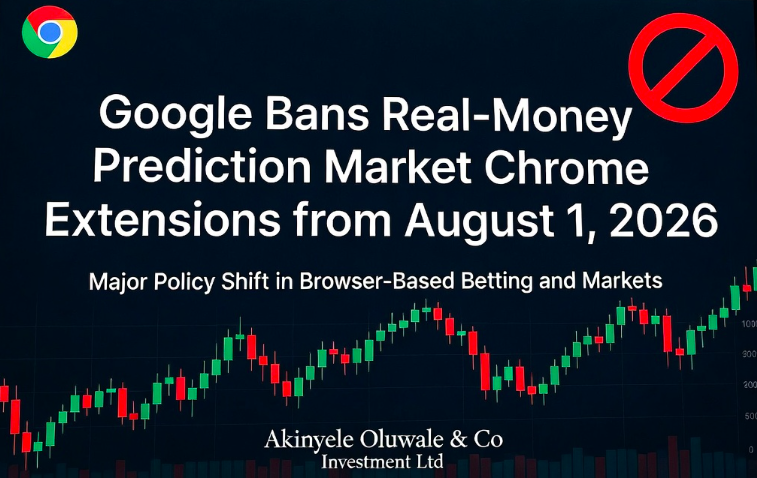
In a significant move that could reshape the intersection of technology, finance, and online betting, Google has declared it will ban Chrome extensions that support real-money prediction markets starting August 1, 2026. This policy targets platforms and tools that allow users to place wagers on real-world events — from political elections to sports outcomes and financial markets — directly through browser extensions.
The decision comes amid growing regulatory scrutiny of online gambling and prediction markets worldwide. Key reasons include:
Chrome extensions that:
Extensions focused on information-only prediction markets (non-monetary) or educational tools are expected to remain permitted.
For Users:
For Developers:
This move reflects Big Tech’s increasing caution toward gambling-adjacent activities. It aligns with similar actions by Apple and other platforms to limit real-money gaming features.
For the Prediction Market Industry:
For Regulators:
While this ban limits accessibility, it may ultimately push the industry toward more regulated, transparent, and user-friendly platforms. The rise of decentralized finance (DeFi) and Web3 could provide alternative avenues for prediction markets to thrive.
Conclusion Google’s decision to prohibit real-money prediction market extensions from August 1, 2026, marks a pivotal moment in the evolution of online betting and information markets. It highlights the tension between innovation, regulation, and platform responsibility in the digital age. As the industry adapts, the focus will likely shift toward more robust, compliant, and decentralized solutions.