Global Companies Turn to Chinese AI Models as Cost, Control and Digital Sovereignty Reshape the AI Market
By Akinyele Oluwale & Co. Investment Ltd.
The global artificial-intelligence industry is entering a new phase. For several years, the market was largely defined by a small group of American technology companies whose advanced models became the preferred engines for chatbots, software development, research, customer service and workplace automation.
That dominance is now being challenged.
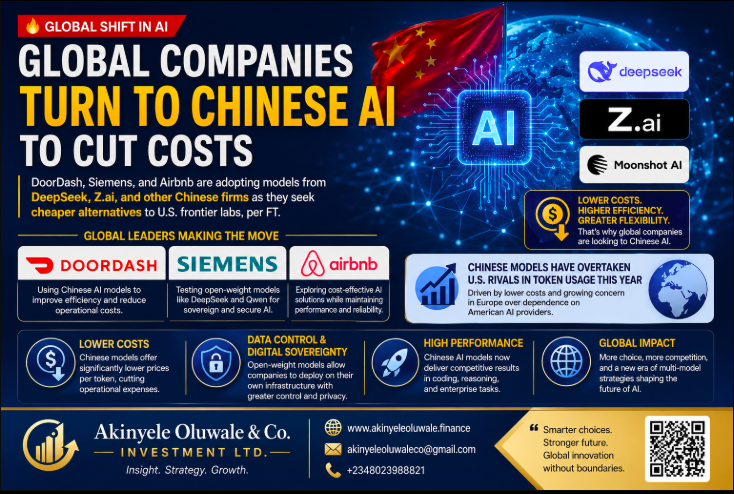
Companies in the United States, Europe and other regions are increasingly testing or deploying artificial-intelligence models created by Chinese developers. Businesses such as DoorDash, Siemens and Airbnb have reportedly used models from Chinese AI groups including DeepSeek, Z.ai and Moonshot AI as they look for alternatives that are cheaper, flexible and increasingly competitive with leading US systems.
This development is not simply a story about China catching up technologically. It reflects a deeper transformation in how companies choose artificial-intelligence infrastructure.
Price remains an important factor, but businesses are also thinking about control, privacy, geopolitical exposure, vendor dependence and the ability to run models on their own servers. The result is a more fragmented and competitive global AI market in which companies may use several models from different countries rather than relying exclusively on one provider.
Why Chinese AI Models Are Attracting Global Companies
The most immediate attraction is cost.
Large AI models charge users based on the volume of information processed. This is generally measured in tokens, which represent units of text sent to and generated by a model. When a company uses AI occasionally, the cost may appear modest. At enterprise scale, however, millions or billions of tokens can be consumed every day.
A delivery company may use AI to interpret customer requests, optimise logistics, generate software, support merchants and respond to users. A manufacturing company may deploy AI across engineering, equipment maintenance, supply chains and technical documentation. When these systems operate continuously, even small differences in token prices can produce major annual savings.
Chinese model developers have competed aggressively on price. Some of their models reportedly cost only a fraction of the amount charged by leading American providers for comparable workloads. The Financial Times reported that certain Chinese alternatives can be between 10 and 60 times cheaper, depending on the model and use case.
Independent reporting has also illustrated the scale of the difference. One developer interviewed by Rest of World estimated that an hour-long coding session costing about $10 through one premium US model could cost less than 50 cents using DeepSeek. That example is anecdotal and should not be treated as a universal price comparison, but it demonstrates why developers and corporate technology teams are paying attention.
From Cheap Alternatives to Serious Competitors
Low cost alone would not be enough to drive adoption if the models performed poorly.
The more significant development is that Chinese models have improved substantially in reasoning, programming, mathematics and document analysis. DeepSeek’s models, Alibaba’s Qwen family, Z.ai’s GLM models and Moonshot AI’s Kimi products have become credible alternatives for a growing number of enterprise tasks.
Chinese developers have also embraced open-weight distribution. Open-weight models make their trained parameters available for companies to download, customise and operate on their own infrastructure, subject to the applicable licence.
This gives organisations more control over where data is processed and how the model is configured. A company can place the model inside a private cloud, a secured data centre or an on-premises system instead of sending every request to an external AI provider.
Siemens has publicly described its work on a sovereign AI platform and confirmed that it has experimented with popular open-weight models including Llama, Qwen, DeepSeek and GPT-related systems. The objective is to create an environment that is self-contained, sustainable and cost-effective.
That approach is especially relevant to industrial companies. Siemens operates in sectors such as manufacturing, transportation, energy, infrastructure and healthcare, where reliability, confidentiality and technical precision are essential. Its broader AI strategy emphasises systems designed for real-world industrial environments rather than consumer chat alone.
DoorDash, Airbnb and the Multi-Model Strategy
According to the Financial Times, DoorDash and Airbnb are among the companies using Chinese-developed AI tools. The significance is not necessarily that these firms are replacing every American model. Instead, they appear to be adopting a multi-model strategy.
Under this approach, a company chooses different models for different tasks.
A premium American frontier model might be reserved for highly complex reasoning, sensitive business decisions or important customer interactions. A lower-cost Chinese model might handle routine coding, summarisation, classification or automated workflows where the difference in quality is small but the difference in cost is substantial.
This model-routing approach can reduce expenses without forcing a company to depend entirely on one provider.
It also creates competitive pressure. If businesses can move workloads among several models, AI developers must compete more aggressively on price, performance, reliability and service quality.
The era in which enterprises automatically selected the best-known US model for every task may therefore be ending.
What the Token-Usage Claim Really Means
The statement that Chinese AI models have overtaken American models in token usage is based on data from OpenRouter.
OpenRouter is a platform that enables users and developers to access many AI models through a single interface. Because it processes requests across several providers, its data offers a useful indication of which models are gaining popularity among developers using the service.
According to the Financial Times, Chinese models surpassed US-developed rivals in the number of tokens processed on OpenRouter during the period examined.
This is an important signal, but it requires context.
OpenRouter represents only one part of the AI market. It does not capture every request made directly through OpenAI, Anthropic, Google, Microsoft, Amazon, Alibaba, Baidu or other private enterprise systems. Large organisations may also run open-weight models internally, and those tokens would not necessarily appear in OpenRouter’s public figures.
The data therefore shows that Chinese models have achieved major usage momentum among OpenRouter customers. It does not prove that they have exceeded US models across all global consumer, corporate and government AI activity.
Nevertheless, the development is notable. OpenRouter is widely used by developers who can easily compare competing models. Rising token consumption suggests that Chinese models are not merely being tested out of curiosity; they are being used for meaningful workloads.
Europe’s Search for Digital Sovereignty
Cost is only one part of the story. In Europe, concerns about technological dependence have become increasingly important.
Many European governments and businesses rely heavily on American cloud platforms, software companies and AI developers. This creates strategic risks.
A provider may change its prices, modify its terms, restrict access to a particular model or be required by its government to limit service in another country. Companies may also worry about whether sensitive data is exposed to foreign legal jurisdictions.
These concerns have strengthened calls for digital sovereignty, meaning the ability of a country or organisation to control its data, infrastructure and essential technologies.
Open-weight models support this objective because they can be installed within European-controlled infrastructure. Chinese models are not automatically sovereign merely because they are open-weight, and European organisations must still examine licences, security, training data and legal risks. However, the ability to download and independently host a model gives businesses more flexibility than depending entirely on a closed foreign API.
The Financial Times reported that European interest has also been influenced by fears that US companies or authorities could restrict access to AI services. Even when proposed restrictions are later reversed, the possibility alone can alter corporate planning.
For European businesses, the issue is becoming less about choosing between America and China and more about avoiding dependence on any single country or supplier.
The Open-Weight Advantage
Open-weight AI models offer several strategic benefits.
First, they can be customised. A manufacturer can adapt a model to engineering documents, technical terminology and internal workflows. A bank can fine-tune a system for compliance and risk analysis. A retailer can optimise it for product information, inventory and customer service.
Second, they can be self-hosted. Sensitive corporate data can remain inside a controlled computing environment.
Third, they reduce vendor lock-in. A business is less exposed to sudden price increases or changes in access conditions.
Fourth, they enable experimentation. Developers can examine model behaviour, modify components and integrate the technology into specialised systems.
These advantages do not mean open-weight models are free to operate. Companies must still pay for servers, GPUs, electricity, engineering, cybersecurity, monitoring and maintenance.
The cost comparison must therefore consider the full lifecycle of the system rather than only the advertised token price.
For a small business, paying for a hosted API may remain cheaper and simpler than operating an AI model internally. For a large organisation processing enormous volumes of requests, self-hosting may offer substantial savings.
Security, Censorship and Governance Risks
The growing adoption of Chinese AI models does not eliminate important concerns.
Companies must assess cybersecurity, data handling, model safety, reliability and potential political restrictions.
Some research has identified weaknesses in the safety controls of DeepSeek models, particularly when they are tested against harmful or adversarial prompts. Academic evaluations have reported vulnerabilities that require further mitigation and model hardening.
Chinese-developed systems may also reflect local regulatory requirements concerning politically sensitive subjects. This could affect outputs in areas such as history, geopolitics and public policy.
For many enterprise applications, such as coding, document extraction or industrial maintenance, these issues may be less relevant. However, organisations must still test models carefully before deploying them in customer-facing or high-risk environments.
There is also a geopolitical risk from the Chinese side. Reuters reported that Beijing has considered placing restrictions on overseas access to China’s most advanced future AI models, reflecting concerns that AI is becoming a national-security asset. The proposals were still under discussion at the time of reporting.
This means companies seeking to reduce dependence on US providers could eventually become exposed to Chinese restrictions instead. A truly resilient strategy therefore requires diversification rather than simply switching allegiance from one national ecosystem to another.
Competition Could Lower AI Costs Worldwide
The emergence of strong Chinese models is likely to benefit corporate users through greater competition.
When only a small number of companies provide advanced AI, they have considerable pricing power. As more capable models enter the market, businesses gain leverage.
US companies may respond by lowering prices, releasing smaller and more efficient models or offering more flexible deployment options. Chinese developers may continue improving performance and international support. European and Middle Eastern companies may accelerate their own sovereign AI projects.
The result could be a more diverse marketplace where enterprises select models according to workload, cost, privacy and performance.
This development may also encourage the rise of AI-routing platforms. These systems automatically send each request to the most suitable model. A difficult scientific question may be assigned to a top frontier system, while a simple email classification task goes to a much cheaper model.
The future enterprise AI stack may therefore resemble a diversified investment portfolio rather than a single-provider contract.
Implications for Investors
For investors, the trend raises several important questions.
The first concerns the sustainability of premium AI pricing. If open-weight Chinese models can deliver acceptable performance at dramatically lower costs, the margins of leading US AI providers may come under pressure.
The second concerns infrastructure. Cheaper models may stimulate more AI usage, increasing demand for data centres, semiconductors, cloud computing, electricity, cooling and networking.
The third concerns software companies. Businesses that build model-independent platforms may benefit because they can integrate the best available model rather than being tied to one supplier.
The fourth concerns geopolitical regulation. Export controls, investment restrictions and national-security policies could reshape which models are available in different markets.
Investors should therefore avoid assuming that technological leadership will automatically produce permanent commercial dominance. In AI, cost efficiency, distribution, openness and developer adoption may be as important as benchmark performance.
What This Means for African Businesses
African companies could also benefit from the growing competition among AI providers.
Cost remains a major barrier to adoption in emerging markets. Cheaper models may make AI-based customer service, financial analysis, education, healthcare support and software development more accessible.
Open-weight systems could allow African governments and enterprises to host AI locally, helping them meet data-protection and sovereignty objectives.
However, deploying open models requires technical expertise, computing infrastructure and reliable electricity. Many organisations may therefore prefer regional cloud providers or managed AI platforms that offer lower-cost models without requiring them to operate the technology directly.
African businesses should also evaluate whether models understand local languages, regulations and cultural contexts. A cheap system that performs poorly on African data may ultimately create more cost than it saves.
Conclusion
The report that global companies are turning to Chinese AI models to reduce costs is broadly accurate.
DoorDash, Siemens and Airbnb are among the companies reported to be using or testing models from Chinese developers. Siemens has also publicly confirmed experiments with DeepSeek and Qwen as part of its sovereign AI strategy.
The appeal is based on more than price. Chinese models increasingly offer competitive performance, open-weight availability, customisation and the possibility of private deployment.
The claim that Chinese models have overtaken US rivals in token usage is also supported by OpenRouter data, but it should be described precisely. It reflects activity on that platform, not necessarily the entire global AI industry.
The broader message is clear: artificial intelligence is no longer a market controlled exclusively by a few American frontier laboratories.
Companies are becoming more selective. They are comparing models by cost, performance, security, openness and geopolitical risk. Many are building diversified systems that combine American, Chinese, European and internally developed technologies.
This shift could lower prices, accelerate innovation and reduce dependence on individual suppliers. It could also intensify competition between countries seeking leadership in one of the most strategically important technologies of the century.
For businesses and investors, the winning strategy may not be to choose one national AI ecosystem. It may be to remain flexible enough to use the best model for each task while maintaining control over data, costs and critical infrastructure.
About Akinyele Oluwale & Co. Investment Ltd.
Akinyele Oluwale & Co. Investment Ltd. provides commentary and research on financial markets, investments, artificial intelligence, fintech, digital assets and emerging global economic trends.
Website: www.akinyeleoluwale.finance
Email: akinyeleoluwaleco@gmail.com
Telephone: +234 802 398 8821
Disclaimer: This article is provided for educational and informational purposes only. It does not constitute investment, financial, legal or technology-procurement advice.