

Nigeria’s New Tax Regime: What You Need to Know (Finance Act 2025)
At Akinyele Oluwale & Co., we are committed to keeping our clients informed about the latest regulatory changes affecting businesses and individuals in Nigeria.
The Finance Act 2025 represents one of the most significant tax reforms in Nigeria in recent years. Signed into law to simplify the tax system, reduce multiple taxation, and improve ease of doing business, the Act introduces several key changes:
Major Highlights:
Company Income Tax (CIT) reduced to 25% for large companies (from 30%).
Tertiary Education Tax significantly reduced from 2% to 0.5%.
- Strengthened rules against multiple taxation across federal, state, and local governments.
- Expanded scope of Value Added Tax (VAT) on digital services and luxury goods.
- Higher exemption thresholds for Capital Gains Tax and Personal Income Tax.
- Mandatory digital compliance through the new Rev360 platform.
New Tax Portal – Rev360
The Federal Inland Revenue Service (FIRS) has launched Rev360 (www.rev360.gov.ng), a unified digital platform for all federal tax filings and payments. This new system makes tax compliance easier, faster, and more transparent.
Our Advisory
These reforms present both opportunities and compliance requirements for businesses. Early adaptation will help you avoid penalties and optimize your tax position.
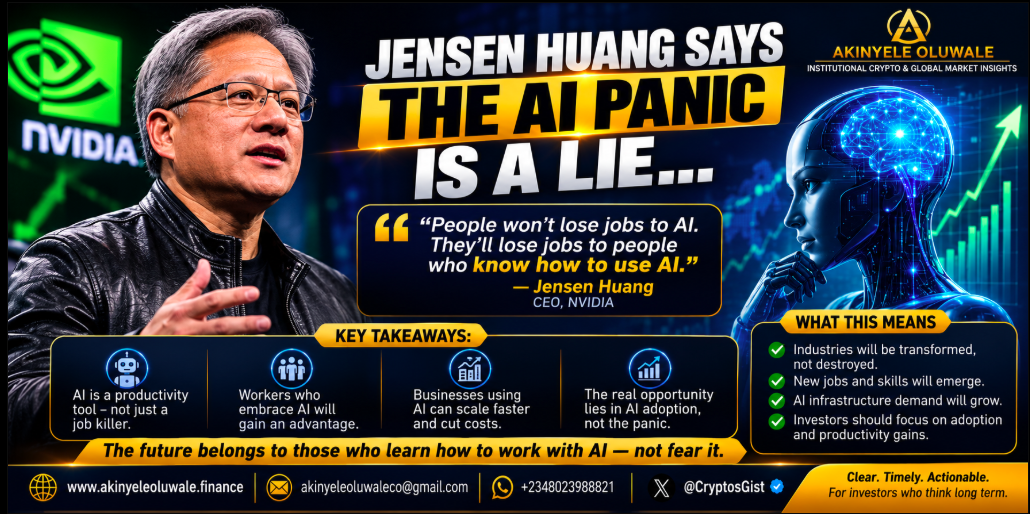
Jensen Huang Says the AI Panic Is a Lie: Why the Real Risk Isn't AI—It's Being Left Behind
Executive Summary
NVIDIA CEO Jensen Huang has challenged the growing narrative that artificial intelligence is destroying jobs, arguing that the real threat is not AI itself but failing to learn how to use it. His comments shift the conversation from fear to adaptation, highlighting AI as a productivity tool rather than simply a replacement for human workers. For investors, the bigger story is how AI adoption is transforming industries, creating new business models, and driving demand for AI infrastructure, software, and digital skills.
Introduction
Few voices carry more weight in the artificial intelligence industry than NVIDIA CEO Jensen Huang.
As the leader of the company powering much of today's AI revolution, Huang has a unique perspective on where the technology is headed. While concerns about AI replacing millions of jobs continue to dominate headlines, Huang believes the discussion is missing the bigger picture.
According to him, the idea that AI is simply taking people's jobs is misleading. Instead, he argues that workers who embrace AI will outperform those who ignore it.
This distinction has significant implications for businesses, employees, investors, and policymakers.
What Jensen Huang Means
Artificial intelligence is rapidly automating repetitive tasks such as writing basic reports, analyzing large datasets, generating software code, creating digital content, and assisting with customer support.
However, Huang argues that automation does not necessarily eliminate entire professions.
Instead, AI enables professionals to complete work faster, improve productivity, and focus on higher-value activities.
Just as calculators did not eliminate accountants and spreadsheets did not eliminate financial analysts, AI may transform jobs rather than replace them entirely.
The competitive advantage will increasingly belong to individuals and organizations that know how to integrate AI into their daily workflows.
The Bigger Economic Picture
History shows that technological revolutions often create short-term disruption while generating long-term economic growth.
The Industrial Revolution replaced many forms of manual labor but created entirely new industries.
The internet transformed commerce, communications, and financial services while creating millions of jobs that did not previously exist.
Cloud computing changed software development and gave birth to entirely new business models.
Artificial intelligence appears to be following a similar pattern.
Rather than eliminating work altogether, it is reshaping how work is performed.
Why Investors Should Pay Attention
For investors, the most important question is no longer whether AI will influence the economy.
That question has largely been answered.
The more important questions are:
NVIDIA has become one of the world's most valuable companies because it supplies the computing power required to train and operate advanced AI models.
But opportunities extend beyond semiconductor manufacturers.
Cloud providers, cybersecurity companies, enterprise software developers, robotics firms, healthcare innovators, and financial technology businesses are all investing heavily in AI.
Who Benefits?
Several groups are positioned to benefit from widespread AI adoption:
Potential Risks
Despite its enormous potential, AI presents genuine challenges.
Certain administrative and repetitive roles may decline as automation improves.
Organizations will need to invest in employee training to prevent workforce displacement.
Governments may introduce new regulations covering AI safety, privacy, intellectual property, and ethical standards.
The pace of technological change could also widen the gap between businesses that adopt AI quickly and those that do not.
My Analysis
Jensen Huang's comments should not be interpreted as suggesting that AI poses no disruption.
Instead, they highlight that the greatest risk may be resisting change rather than embracing it.
The companies likely to outperform over the next decade will not simply own AI technology—they will successfully integrate it into every aspect of their operations.
Likewise, professionals who learn to work alongside AI are more likely to remain competitive than those who ignore it.
The investment story is therefore broader than AI itself.
It is about productivity, digital transformation, innovation, and long-term economic competitiveness.
Conclusion
Artificial intelligence is reshaping industries at a pace few technologies have achieved.
While concerns about job displacement are understandable, history suggests that technological progress tends to create new opportunities alongside disruption.
Jensen Huang's message is ultimately one of adaptation rather than fear.
For investors, businesses, and workers alike, the focus should be less on whether AI will change the future and more on how prepared they are for that future.
Read more institutional crypto, AI and macro insights: